
Te spectem, suprema mhi cum venerit hora,
Et teneam moriens deficiente manu.
May I be looking at you when my last hour has come,
and dying may I hold you with my weakening hand.
— Tibullus (50-19 BC)
 Episode
I had an epiphany one morning on the way that memory edits itself.
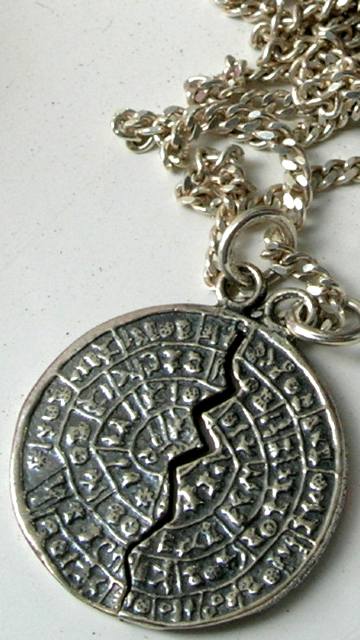 During my 2007 trip, I bought a small silver pendant representing the famous Phaestos Disc. Like those silver or gold hearts that can be broken in half to share with someone, this could be broken in half. So much is fact.
Over time I built a romantic little anecdote around this pendant. It started out simply factual, but each time I repeated the story I “improved” upon it. Not unusual — I’m a storyteller and it’s in my nature to attempt to make the most of a good yarn, filing off the rough edges to make it rounder, neater and hopefully more interesting. Usually I keep track of fact and fiction in my head and don’t confuse them, but in the case of the pendant, I actually came to believe the new version.
According to the ultimate version of the anecdote, I bought the pendant in Crete after a brief, intense relationship, to remind me of the event, planning to give one half of it to her should I meet her again, or else to some other fellow traveller who seemed deserving of it.
I did not question this story. I “knew” it so well that there seemed no reason to go back and check my records. But one night I was browsing through my photos from 2007 looking for something else and I came across a picture of the pendant — taken in Methoni, over a week before I reached Crete. There was an obvious contradiction here. If I already had the pendant in Methoni then I could not possibly have bought it in Crete!
I checked my record of expenditures on my 2007-2008 trip and the truth began to emerge. In fact I purchased the pendant in Corfu on the 11th of June 2007. I already had it in Crete. Indeed, now that I was looking for it, I could see it around my neck in photos taken on Crete. Therefore that part of the fable was not only false to fact but false to itself. If I’d really bought the thing with Helle in mind, I could have given it to her then and there!
Faced with these facts I dug back and gradually unwound the mysteries of the anecdote. I had indeed bought the pendant intending to give it to a travel companion somewhere, sometime, should the case ever arise, but I bought it in memory of the breakthrough in Corfu, not of the relationship on Crete. I did not give it to Helle on Crete because we were not travelling together — she did not fit the profile.
The truth is not as poetical or romantic as the anecdote. It has loose ends and too many characters. So I improved the yarn. And I liked the improved yarn so much that, over time, I forgot that it was just a yarn.
Writing about real events can be as much an act of creativity as writing a novel. Memory is not a video recording: each time we recall a memory, we change the memory minutely. Writing from memory alone, you run a real risk of setting down an edited, artificial version of events. If that fits your purpose, fine. Otherwise, there is no substitute for keeping an honest, clear diary as things happen.
In writing this account I have had to spend as much time and effort in removing the dreamer’s fancies as setting down the events that the adventurer remembers.
 Table of Contents
A tale of three Tourist Information Offices
Osh to Sary Tash, Irkeshtam and Kashgar
Money switching at Tu Duc Tomb
Saigon and Chau Doc
Saigon
Saigon to Chau Doc
Chau Doc to Phnom Penh
Winter in Cambodia
Sihanoukville
Phnom Penh
Phnom Penh to Battambang
Battambang to Siem Reap
Siem Reap
Temples of Angkor
Farther Afield
Northern temples
Siem Reap to Preah Vihear
Sra Em
Prasat Preah Vihear
Tbeng Meanchey
Koh Ker
Phnom Dek
Preah Khan Kompong Svay
Kratie
Sen Monoram
Kipping In Laos
Don Det
Champasak
Tad Lo
Pakse
Vientiane
Phonsavan
Nam Noen
Nong Khiaw
Luang Prabang
Pak Beng
Huay Xai
Time For Thailand
Chiang Rai
Chiang Mai
Sukhothai
Khon Kaen
Nong Khai
Khorat
Lopburi
Ayutthaya
Bangkok
Kanchanaburi
Ko Pha-Ngan
Khao Sok
A passport to Malaysia
Khota Baru
Taman Nagara
Kuala Lumpur
Melaka
Georgetown
Sumatran excursion
Last boat to Tuk Tuk
Tuk Tuk
Pulau Weh
Banda Aceh
Just My cup of Java
Jakarta
Borobudur
Malang
Bali high
Ubud
Kuta
The Gleam
Cells in the Matrix
Reunion
Envoi
§
Note on currencies: in this trip report, I’ve chosen to use Latin rather than unicode for some currencies. “$” on its own is always the Australian Dollar (aud) unless it's in a quotation. For the rest, in the rough order in which they are encountered,
us$ = US Dollar (usd).
€ = Euro (eur).
₺ = Turkish Lira (try).
₾ = Georgian Lari (gel).
֏ = Armenian Dram (amd).
₼ = Azerbaijan Manat (azn).
₸ = Kazakhstan Tenge (kzt).
⃀ = Kyrgystan Som (kgs).
лв = Uzbekistan Sum (uzs).
sm = Tajikistan Somoni (tjs).
؋ = Afghanistan Afghani (afn).
¥ = Chinese Yuan Renminbi (cny).
hk$ = Hong Kong Dollar (hkd).
mop$ = Macau Pataca (mop).
₫ = Vietnam Dong (vnd).
៛ = Cambodian Riel (khr).
₭ = Laos Kip (lak).
฿ = Thailand Baht (thb).
RM = Malayasia Ringgit (myr).
Rp = Indonesia Rupiah (idr).
I've generally left out prices except where they’re relevant to the yarn. Unless noted otherwise, any exchange rate in the text is the rate applying at that time in 2010–2011.
Here and there I’ve changed or omitted some names of people I met. I won’t always warn you when I do that. It’s usually either because I’ve forgotten the name, or else to protect their privacy.
“Life is like a dogsled team. If you ain’t the lead dog, the scenery never changes.”
— Lewis Grizzard.
Adrift in MelbourneSpurning Richmond, I took a flat in many-cultured Footscray. I also took a package from my job and spent a year off work, writing, and seeking my family roots. I tried to make sense of what I’d done, what I’d learned, what I was, and what I’d become.
I started writing a book about my 2007 adventure. It started out as a collection of diary notes, forum posts, and other bits and pieces, laid out by the calendar, and gradually transformed into a travelogue, then into philosophy. I didn’t know where I was going with it, but it organised my memories and I felt that if I kept working on it, it might help me understand what had happened.
The book was never completed — it became obvious to me that the story I was trying to tell was itself incomplete — but it did clarify many things to me. Ten months on the road had changed me, but not enough. I had found magic but I had not brought it back with me. My life was still empty.
Then the money ran out and I had to take contract work. Without an anchor, I backslid, rapidly falling back into my old ways.
A choice presented itself. I could stay in Australia and stagnate, or I could take to the road again in hope that once out of the matrix I could complete my transformation. Put that way, the choice was easy. I took the red pill.
My employer offered to extend my contract again, but this time I refused. Anzac Day 2010 marked the 95th anniversary of the Gallipoli landings. It seemed as good a time and place as any to restart my quest.
Man in the rainEvery so often on any trip I experience moments of sublime happiness — when I am where I need to be, when I need to be there, with nothing that needs to be done immediately and plenty of time to simply enjoy the moment.
My first such moment on this trip was yesterday at 10:15 on a tram back from Richmond, stopped for the lights at the corner of Bridge and Punt Roads. I had just arranged for my mail to be redirected from my former address, and for my Post Office Box mail to be held while I am overseas. These were the last chores I had to do before departure. I had been trying to think of anything I had forgotten or left out — and coming up empty. Suddenly I felt a smile spreading across my face and all the stress and tension of the last few days dissipated. As the tram rumbled across the intersection, I looked around me at all the scowls and tight faces of people still tied to the daily grind and had to resist the urge to laugh. For the next year, people, I would be among you but no longer of you.
This is freedom!
 Packing was a process I’d gone through before. It involved deciding what was worth storing and what was better discarded, to be replaced, or not, when I returned.
Last time I had thrown out practically all my furniture. So this time a lot of nearly new furniture had to be stored. However, the TV and its stand went out; they were too big, and I no longer watched TV. I could buy a digital flat screen setup when I returned. The stereo was overdue for the junkyard too, but in the end I stored it (and threw it out in 2011). Washer, dryer and fridge were for the curb (not worth trying to sell).
In late March I performed triage on my books and discarded several hundred, packing the rest into the same cardboard boxes they’d occupied during my last long trip. My bookcases and shelves were nearly all kit sets and I reduced them to compact stacks of boards and tubes for storage. Most of my VHS collection got deep sixed, but I kept the DVDs. Several boxes of plastic and electrical bric-a-brac went to the curb, also a couple of old sets of drawers that I originally salvaged from the roadside; time I bought some new ones. My old desktop computer went to the curb too (ten years old and not worth trying to sell second hand; I industrial-wiped the hard drive first). Most of my work clothes also went in the trash, this time — I accepted that I would never wear them again.
Once my stuff was settled, I still had a few days in hand. I used that time to print bits and pieces and finish last minute planning. I slept on an air bed that rolled up and went to storage when I vacated the flat. Since I was throwing the fridge out, I kept it for now and thus had cold storage, so with pots, disposable plastic plates and utensils, the flat was habitable right up until I moved out.
But my last week in Melbourne I spent in a backpacker hostel, getting myself back into travel mode and saying goodbye to — all of that.
My laptop too went to storage on my last day in Melbourne. In 2007 I had looked around me in the hostel common room, at the people seeing their journey through a shining glass window, and decided I did not wish to spend my priceless time free in the world like that. As in 2007 I carried only my mobile phone (charged but hidden away, for emergencies) and my trusty Pocket PC.
It felt strange and yet familiar to be on the road again. Strange because I’d had months of sleeping in the same bed every night. Familiar, to be on the move, carrying all my belongings. My pack, the same one I’d carried on my previous long trip and on my other, more recent recent excursions, rode my back like it had grown there, but lighter now; all the dross had been identified and discarded during 2007.
At the airport, the internet Net-kiosk refused my coin. A quick manoeuvre with a key flipped someone’s jammed $2 coin from the slot. Score! It seemed like an omen.
The flight out of Melbourne was half empty. I spread myself across two seats and slept curled up. Some lucky people in the middle got four seats in a row and could lie completely flat.
At Abu Dhabi a hot shower spruced me up, and at a coffee shop in the mezzanine, a monster cappuccino in a cup with two handles — the “Massimo” — was just what I needed to wake me up. That, and excitement over the odyssey ahead.
From Abu Dhabi to İstanbul, the flight was completely full. I did not exchange a word with my neighbours the whole way. We communicated our few needs by grunts and body language.
We have reached the Colchian land and the stream of Phasis; and it is time for us to take counsel whether we shall make trial of Aeetes with soft words, or an attempt of another kind shall be fitting.
— Apollonius, Argonautica.
İstanbul ReprisedAfter a gap of nearly three years, I slipped back into İstanbul like a foot into a well-worn shoe. On a whimsy, I’d booked a room at the same hotel I used in 2005. It was in a side street off the end of the Hippodrome and was mid-range when my budget on this trip called for something cheaper, but a little transitional luxury seemed called for. I’d be sleeping cheaply soon enough.
The weather was perfect — not too hot, not too cold, and it was sunny. I had my first breakfast on my hotel’s terrace, overlooking the Hippodrome and the great mosques. Far out in the Sea of Marmaris I could see the Princes Islands. Coffee, cereal, thick slices of bread and jam, and an envious seagull standing witness. My journey was off to a splendid start.
I went to Ayasofya in the hope that the scaffolding concealing a quarter of the immense dome would be gone. It had been moved aside, so I finally saw the entire glorious dome. Another dream fulfilled.
I also went back to the Basilica Cistern and the Mosaic Museum, perennial favourites.
The sightseeing was a little bitter-sweet. Last time I saw these sights, I was showing them off to a pretty Chinese woman, seeing them afresh through her eyes. Evelyn cured the pain left in my heart from my reawakening in Greece. We had stayed in touch since. She had visited Australia and I showed her some of my favourite Melbourne sights, and I hoped to see her again on this trip, when I reached China. Meantime, I was again seeing these things from two vantages — from 2007 and from now. The present suffered by comparison.
While I was crouching to take a photo, I felt something give way at my waist. My belt had snapped. It was an old braided-leather thing that had been on its last legs. I brought it with the intention of replacing it with a better one in Central Asia. Well, now I could make an unplanned-for visit to the Kapalı Carsı to buy a new belt, identical to the old one. I paid too much for it, but my need was great!
Afterwards I sat at a tiny table in the market and sipped çay from a tulip glass to recover from the excitement and enjoying some illicit tourist-watching. Tourists were everywhere. This did not bode well for Anzac Day. If there was a bumper attendance like 2005, Gallipoli would be a mosh pit.
I did some other shopping. A sheet of plastic to lay on the ground — or over my head, should it rain — while waiting for the dawn at Gallipoli. Munchies for the vigil — cheese, coffee, chocolate bars. A blue-and-white glass eye to put on my daypack to ward off ill luck. I did some overpriced laundry.
It gave me an excuse to walk around the city, and the minor quests and the activity quenched my melancholy.
I found my New Thing of the Day — Black Olive Paste. The brand name was Marmarabirlick. Muggins decided this meant it was some sort of marmalade made from a dark fruit, like a plum. Surprise! The scent of olives when I opened the jar told me I had discovered a new taste sensation. Bread, cheese, olives and water for lunch: behold, the Mediterranean diet!
Gallipoli and the CoastAnzac Day at Gallipoli turned out to be a considerably smaller event than 2005, with only about 7,000 attendees. However, everything I had planned for the 24th was screwed up by security arrangements for the VIP dignitaries such as NZ’s Prime Minister and Australia’s Governor General and the Governor of Çanakkale. Owing to the obvious risk of World War III breaking out should any of these stuffed shirts brush elbows with the peons, the entire Anzac area was locked down and the public were excluded from 10:00 to 17:00. Instead of sightseeing, we wound up cooling our heels in Eceabat. I thought these clowns were elected to wait on us, not we on them! We were the ones who paid to be there — and we also got to pay for these politicians to be there.
Despite this, security at the site was rather spotty. My bag, containing a bottle of water and various esoteric electronic devices, sailed through the scanner unhindered. The gate beeped enthusiastically when my brand-new belt’s buckle passed through, but nobody even looked. One guy managed to smuggle in a bottle of Scotch. He would have been OK, except he went out and came in again. They spotted it on the return leg — and let him take it in any way! (It was a futile victory: as he sat in the stands, the bottle fell through a gap in the boards and broke.)
I made a beeline for the enclosure nearest the stage and claimed a sleeping-bag-sized patch of ground. It became my home for the next twelve hours. Due to the smaller attendance, I managed to retain my spot and even sleep there.
The event otherwise was much like 2005. During the closing stages I thought of the futile waste of human life 95 years before and wondered, really, how much we had learned.
We got away faster this year and reached Ayvalık in time for our free buffet dinner (drinks extra … and expensive). Fez Tours had managed to negotiate an upgrade to a “four star” hotel (Hotel Kalif). However, they must have been very small stars. My shower had a hand-held shower head and no curtain. The bathroom door would only open 45 degrees because at that point it hit the bathtub. The light switches for the bed lights were reversed — the left switch operated the right light and vice versa. You’d think a 4-star hotel would notice and fix things this obvious! But the food was good, and abundant. I’ll grant them that.
On the 26th we had three things scheduled — a visit to a carpet factory, a visit to Pergamon, and a visit to an onyx factory. We ran over time at the carpet factory and had to make it up — by shortening the Pergamon tour, as it was obviously impossible to shorten the onyx factory tour (they might want their commission back).
The frightening thing was that quite a few of the tour members really were more interested in the sales pitches, I mean, factory tours, than the ruins of ancient Pergamon.
I took a dolmuş to the centre of Kuşadası then a dolmuş to Selçuk, where I booked a bus to Bodrum before heading off to see the sights.
I skipped Ephesus, which was still fresh in my mind from 2007, but I revisited the site of the Temple of Artemis, the Archaeological Museum and the Basilica of St John. When I got back to the bus station, I learned that my bus had encountered “mechanical problems” in İzmir and was cancelled — translation, there were not enough bookings — and my reservation had been transferred to a bus departing two hours later. Grrr. Instead of browsing pensions in Bodrum, I was forced to pick one out of my guidebook and ring them to make a reservation.
But I made it to Bodrum, and my room was waiting — a better room than I expected, because they upgraded me to a room with bathroom at the same price, since I had rung ahead to reserve a place. Not that things went as smoothly as that implies. The bus ran late. Coming out of the bus station, I turned east instead of west and promptly got lost. No matter. I was in Bodrum as planned, and I decided to stay two nights instead of one.
Ancient Halicarnassus had changed since ancient times, but Herodotus might be able to remember the hills. It had changed little since my last visit. I wandered around and revisited places. I went to the Mausoleum — a rubble-strewn hole in the ground — and the Castle of the Knights — whence most of the missing Mausoleum pieces had been taken. I also sat for a fistful of visa photos. I had a notion they might come in useful.
Near the Mausoleum I thought of buying half a litre of water because the one I was carrying was mostly tap water. I paid 50¢ in Istanbul and 20¢ in Ayvalık — I expected 30¢ or 40¢ here, but he demanded 50¢. This may have been the correct local price (others charged the same) but I queried it with the jolly, unshaven shopkeeper. He affirmed it. I was still doubtful — at which point he reached over, took the bottle and handed me back my 50¢. That was no problem as I was going to back out anyway, but he laughed and made a remark to another customer, probably derogatory. That got my back up.
I went up to the Theatre and had a look round, as planned. But on my way back I took out my own bottle and made a point of stopping outside the shop to have a good guzzle. When I knew he had seen me, I laughed nastily, just as he had — and walked on. Hopefully, he wasted some skull-sweat trying to figure out where I got my (presumably) cheap water. It may also improve his manners, but I somehow doubt that.
Fethiye was a pretty town spread around a bay — quite reminiscent of Dunedin in New Zealand. There was still snow on the higher peaks. Until the snow melted, I was in no hurry to get to Georgia, where spring came later. Even so, the weather was changeable — bright sunshine in the morning, but a thunderstorm in the afternoon.
The view from the pension terrace was to die for, but the place had a couple of unfortunate quirks. They had a rule against doing your laundry in your room. This was reasonable, but they provided no alternative except their absurdly overpriced in-house service. The promised 24-hr hot water was decidedly tepid in the mornings — they seemed reliant on sun power and the afternoons while I was there were cloudy.
The sights that were open were overpriced. You could see the façade of the Tomb of Amyntas pretty well from the road below. The interior would have to be amazing to make entry worthwhile — and I had not heard that it was amazing.
By the waterside, I stopped at a roadside stall selling lightweight travel trousers and bought a pair. Too long, but they could be shortened. Then I found another stall selling packs and bought the perfect daypack. After that, I bought two spools of cotton thread — grey to shorten the trousers, black to attach secret pockets and caches and D-rings and webbing to the pack.
I continued along the waterfront and found a place with cheap çay and two resident pelicans. The pelicans provided plenty of entertainment when they “did the rounds” of the tables trying to bully people into feeding them. A seat cushion made a handy pelican defence, but it took a man wielding a broom to rout them.
Back at the hostel I had a beer while I did some internet on my Pocket PC, then I sat on a shady platform and shortened my new pants. The cut-off bits left over from this exercise suggested that I could now patch the old pair — something of a laugh since the new pair were supposed to replace the old!
At the Şaban Pension I plumped for a bungalow rather than a treehouse — a bit of a splurge, but breakfast and dinner were included. The food was well up to par.
I spent hours lying in a hammock beneath a shady tree or lying on cushions in a pergola. If I felt energetic, I could get up and take a walk through some atmospheric ruins down to a pretty beach. It was spring and the weather was perfect. I was surrounded by enthusiastic young backpackers ready for a conversation at the drop of a reminiscence. But it was still early in the trip and I was not yet lonely.
I took a Chimæra tour — in fact, I had come to Olympos specifically to see the Chimæra. We left after dinner. The drive from Olympos to the car park went via the main road and took 45 minutes. It was then a stiff thirty-minute climb up rough stone steps to the flames. The driver handed out bright LED torches to those who had brought none. Some smart people brought sausages and barbequed them at the bigger flame vents: remarks about “we should’ve brought some marshmallows” were common.
I did my laundry in the morning, then set out for Side around 11:00. The journey took about 4 hours and four changes, from climbing into one dolmuş at Olympos to climbing out of another at Side.
My 20 minute walk through the ruins of Side looking for accommodation was pleasant. The city was mostly open and free. The Theatre didn’t look worth its price (I got a good look from outside, though the panorama from the top of the stands might have improved the value proposition). The Museum was closed on Monday. but open Tuesday. The beaches looked good.
I booked into the Beach House Hotel for two nights, then resumed my walk.
My room included breakfast, so once I’d dropped into a couple of supermarkets on my way back to the hotel in the afternoon, my food needs were settled for my time here. That said, Side was a single huge tourist trap. Everything in the old city was geared to the tourist, and the shopkeepers were pushy.
§
The breakfast was modest but very similar to what I had bought for myself the night before — coffee, cucumber, tomato, a slice of baloney, and egg, some cheese, spreads, and a loaf of bread.
I visited the Temple of the moon god Men, victim of some poor choices in the past (rusted steel reinforcing that allowed re-erected columns to fall over). Further on, the ruins of the Temple of Athena had been built over with a Byzantine basilica and only excavatad in modern times. A statue of Ataturk, hands in pockets, gazed casually out over the harbour.
The Museum, open today, was okay. A broken Three Graces had been crudely modified to provide bodyparts that they had lacked. A beautiful head of Hermes, wearing an ironic half-smile, was probably the most impressive piece here. Vespasian’s Fountain still had an arch.
I finished the afternoon in my warm, sunny room with a siesta.
In the morning I took a dolmuş to Manavgat, then a minibus to Alanya, where I caught a bus to Alanya big otogar, Where I boarded a bus to Anamur. But first, toilet stop at Alanya.
I booked into the Dedehan Otel, which I misrecorded as the Bededen, for two nights. It was epensive by my standards,but right next door to the bus terminal. And to a four-minaret mosque, which guaranteed a wake up call in the morning. I had an early dinner — stew and çay — and early bed.
§
In the morning I caught a dolmuş out to the roundabout (36°02'24.4"N 32°48'09.0"E) where Anamuryam Caddesi struck off the the ancient city. From there I walked. Once past the ticket office (36°01'45.5"N 32°48'17.4"E) at about 9:00, I could see the very substantial ruins of Anemourion spread across the hillside in front of me. I could pick out the lines of the walls.
Between the local map board and my guidebook — the Turkey Lonely Planet — I managed to identify the two baths, the theatre, the Odeum, and several churches. The map board was more art than map, but by working out where I was on the ground and using the placards that said what I was looking at, I had a pretty good idea of where I was and what else was nearby.
I worked up the hill, finding huge arched windows that gazed out over the sea, then down to the beach, where the ruins continued right out to the water’s edge on the pebble beach. Here and there crusts of marble were still draped over humbler foundation masonry.
As I started back I saw a suburb of the new city in the distance. It was like a scene from a time travel novel — ancient ruins by a sea, with mysterious tall white towers visible on a hillside in the distance.
The only residents today were tortoises. As I was leaving at about 11:20, I spotted one stalwart working its way sturdily along the modern concrete road. There wasn’t much traffic, but I feared for its life if a car came along, so I lifted it and carried it over to the roadside, pointing it uphill into some grass. It took the hint.
As I walked back to modern Anamur, the apartment towers lost their airy grace and became blocky and mundane. To walk down into the city centre was to enter a miasma of smoke and car exhaust. The road was not designed for foot traffic, but at least the western road edge was broad enough to give me a chance. By 13:00 I was looking at the big mosque opposite my hotel.
Although I had booked in for two nights, I had only done so in order to have the use of the room to rest up in during the afternoon. By 21:00 I was sitting at the otogar, waiting for an overnight Malatya service.
I suddenly thought that if I had extended my contract, I would be squatting in a dismal flat in Footscray right now instead of enjoying a mild night in Turkey waiting for a 21:30 bus after an interesting day’s sightseeing, while a muezzin chanted from the steps of a mosque nearby in a vain attempt to arouse some vestige of piety in the waiting passengers. It would have been the sensible choice.
My hammock days were behind me now. I was impatient, and the road legs were long. I arrived in Malatya after an overnight bus odyssey from Anamur on the coast that included toilet stops at 2:30 somewhere, at Kahraman Maraş, and at Elbistan, because of uneasy bowels.
The day really started at 6:00, with a splendid misty sunsrise somewhere on the road. I was supposed to change to a different service at 6:30 in Kahraman Maraş, but my bus ran late so they took me to Elbistan and changed me there. Instead of 10:30, I arrived in Malatya at noon. The next day I departed for Erzurum.
Malatya was the rudest town I had ever encountered in Turkey. From the moment I arrived I was jostled, cut off, hissed at and treated as a walking wallet; and it was an ugly place. My guidebook claimed that it grew on you — but after 24 hours here the only things growing on me were a film of stale tobacco smoke and a case of deafness from the ridiculously loud loudspeakers on the mosque across the street.
With a choice of spending 10 more hours in Malatya or spending those same hours out at the otogar, I opted unhesitatingly for the bus station. I doubt there can be a more devastating condemnation of a place than that its best feature is the departure plaza of its bus station.
When one chubby middle-aged Turk in an otogar hurdles a counter and goes for another — you just know that it’s not because they have just discovered that they are long lost twins!
Nor was Malatya done with me, even at the otogar.The toilet cost ₺0.75, but —
My humiliation is complete. I scouted the toilets and ascertained that except, maybe, for the (locked) disabled booth or something upstairs, there is no throne in the building. So when it came time to clear the storage facility for the long ride, I had to use a squat.
First I tried the standard squatting position. As expected, I couldn’t be sure my clothing was out of range of possible spatter. So I laid some toilet paper strategically and lowered myself — literally.
And my sphincter, which had been insisting it had some trade to conduct, clammed up totally. I squeezed till I was red and sweating and panting, with no result. Not even a fart.
I ate a chicken doner for dinner, then went back to the squat. Success! That got me on the bus, but getting to Erzurum required two more toilet breaks on the road.
By the time I got to Erzurum at 7:00 the next morning, my mood was as foul as the cold, thunderstormy weather. As soon as I was booked into my hotel, I declared the day to be “down time” and spent it mostly in bed, reading Robin Lane Fox’s 2005 history. The Otel Salim was clean enough, but the upper sheet on my bed was barely large enough and was secured to the blanket with safety pins! Fortunately the cold weather meant that I actually wanted to use the blanket. Gradually my body put itself to rights. I washed some clothes and hoped they’d be dry enough by tomorrow.
Not that the hotel helped. The wall electrical plug dangled loose on its wires. I used it, because I had no choice, but I cringed every time I had to plug someing in.
§
The next day was much better. The rain stopped, the sun came out — though it was only 9°C when I set out to see the town at 7:45.
Highlights: at 32 Menderes Sokak, the huge wall sculptures, one showing water wheels, and next to it one showing soldiers. Brave Turkish Mehmets versus guys in peaked hats who were busy stabbing and bayonetting children. The interesting this is that the brass mural I saw was there until at least 2017, but by 2020 it was black and clearly had different details. The children were gone. Figures were in more neutral stances. Odd.
I explored the Citadel/Castle, climbing up onto the walls to get panoramic views from the city. At one point there was a display of Ottoman cannon. Ekleswhere, a grassy lawn had been dug up to reveal ancient foundations. I saw a black and white bird with blue-flashed wings, apparently an oriental magpie.
Regardless, I had seen enough of Erzurum and I was gone in the morning.
Descending from the mountains, I craned up at the ridges for ancient ruins, and ahead for a first sight of the sea, but I could not claim to have seen either. My “Thalassa! Thalassa!” moment never came.
In Trabzon, my chosen hotel had moved upmarket. I tried to bargain them down, but the guy’s English — passable till now — suffered a sudden deterioration which lasted until I gave up and decided that for one night, I’d pay his price. Shame, as I liked Trabzon and probably would’ve stayed longer if the price had been nearer my budget. Instead, I moved on into Georgia. Though I saw the Kale, I only know it now because I recorded the fact at the time. I have no memory of it.
§
At the border, there was a huge queue to exit Turkey, but it moved fast, and the only delay was while the man made a mental calculation then said “Gelibolu?” to me. I said yes, Anzac Day. He smiled and waved me through. There was nobody at Customs.
Western GeorgiaThere was another queue to enter Georgia. My Passport seemed to puzzle them. They kept flicking through it. My 2007 Russian visa was discovered, and it worked some magic. They made a phone call, perhaps checking whether New Zealanders needed visas, then told me to stand back and look at the camera, then stamped me in (on an otherwise empty page of my Passport, damnit!) with a smile and a “Welcome to Georgia”. Customs was choked with cars and trucks and buses. They weren’t interested in a grubby backpacker and just waved me on.
I had no Georgian Lari but the marshrutka driver said Turkish Lira were “nye problema”, and they weren’t. I decided I was going to like Georgia.
§
I wanted to spend several nights in Batumi to get a feel for Georgia, but they didn’t make it easy. It’d be a nice place if they’d just finish the streets! Half the main grid had been torn up. It was like the Wild West. There were gambling dens on every corner and the Hotel Inturist advertised itself as the “CASINO Inturist”. Batumi was not relying on its stony beach for its tourist appeal.
I rode the poky little Ferris wheel, and discovered my New Thing — a tasty square cheesy pastry — my first encounter with khachapuri.
On reflection, the torn-up streets in Batumi may actually have been a sign of prosperity rather than decline — the authorities may have received a windfall from some of the huge developments going up around town (notably Batumi Resort up by the lighthouse) and decided to spend some of it on replacing decrepit water, sewage, and drainage pipes. Getting in and out of my hotel became an obstacle course when a big trench they were digging reached my front door. The electricity each day was hit or miss.
Roads were a definite issue in Georgia. The road to Zugdidi was not good, but it did prepare me for the infinitely rougher road up to Mestia.
Fleeing the humidity of coastal Batumi, I rode a drunken marshrutka up a mountainside and found a cool haven where my plans for losing weight have been crushed beneath a deluge of food too good to refuse. In partial compensation, I spent hours today marching up and down the town hoping to work off some of the kilojoules. I even set out on an ambitious attempt to climb a nearby peak but proved inadequate to the task.
Aoraki, NZ’s highest mountain, is 3,724 metres high. There are several mountains near me now that top 4,000 metres — one is 4,700 metres. This early in the year, ribbons of snow droop heavily down their flanks and their heads gleam like a collection of old men stooped over a table.
But if you’ll excuse me, there is a fire burning in the yard and people having fun around it. Must dash —
Should have said, “people having fun and good food.” It was a good evening, but I slept uncomfortably that night due to my own gluttony.
The marshrutka I caught to Mestia was Georgian standard — a modified transit van — and it stopped for food and alcohol half-way up the mountain. The road was initially OK, but after the food stop it deteriorated rapidly. This was compensated by the scenery, which improved just as rapidly. In places the road was reduced to a single lane by slips that had originally buried the entire road and had been “cleared” by running a bulldozer through them. In some places paved with concrete the edge of the road had been undercut. This was where the vodka at the food stop came in handy — to help forget that under the outside wheels there was only a concrete crust covering a very long drop! The adventure was further improved by a flat tire halfway up that could have tossed us off the hillside if it happened a few minutes earlier.
Nino’s place in Mestia was legendary in backpacker circles. Room prices included half board, and Nino was determined that no guest should leave her table unfilled — the food kept coming out until the dishes were stacked on top of each other and there was no room for more.
For snacks to turn a walk into a picnic, there was a hot bread shop south of the main street, down a side street east of the square.
One group staying at Nino’s were overlanders, taking an enormous truck converted for passengers with a bus cab, from London to Australia. Despite its hulking, impressive air of power it had already broken down, and I did not envy them their communal adventure.
The town had a Museum, the Svaneti Historical-Ethnographic museum, in a massive, fortress-like building. I shouted Martin, a backpacker even poorer than I was, but I remember nothing of the inside. I also wandered around town admiring the square towers that defended many clusters of buildings. Although they were useless against modern weaponry, the desperation that must have driven people to expend the resources to build them so many years ago could still be sensed.
The graveyards were neat grassy hillsides covered by neat square concrete enclosures. No crypts. I wondered how they coped in winter when the ground was frozen. Did they store the dear departed in sheds until the thaw?
Climbing to the crosses on ridges north and south of the town looked too hard to me, but there was a less strenuous alternative. Left of the Museum’s main entrance was a signposted road going up to the right. This was the beginning of the walk up to the southern cross, a strenuous eight-hour epic. However, I didn’t need to go all the way to the cross to have a good walk. About six kilometres along the track was the abandoned village of Kheshkild, offering a breathtaking view and a superb place to have a picnic lunch.
The first part of the walk was on the road, but this soon deteriorated. Snow lay in hollows beside the road. I tested one berg with a cautious foot: my foot sank in a centimetre or so then found solid ice beneath the mush, leaving a perfect impression behind when I removed it.
I followed the red and white track markers. After a kilometre an arrow pointed uphill to the left. From this point the way ran more or less straight uphill for some distance, with a few zigs and zags. The track was not always the most obvious path leading away from a fork and the correct paths were not always clearly marked. I had to keep my wits about me. At one point I found myself in a big green meadow and had to retrace my steps and try another path, wading up a stream bed to do so. The track was frequented by cattle, who had trodden many places into ankle-deep mud.
After climbing a while the way got steep, but then I came out on a road. After a kilometre or so the road forked. I followed an arrow up the right branch. After a short distance I crossed a ridge and descended into a shallow valley to cross a stream at a culvert. Shortly after that I reached Kheshkild, now just a few crumbling shacks used by local farmers. Their grazing animals kept the surrounding meadow green and tidy.
I laid out my picnic lunch and settled in to enjoy the view. I’d tried to interest some of the other guests at Nino’s in the walk, but they had all chosen either the north cross walk or a ride up to Ushguli. I’d had the opportunity to go to Ushguli, but I dithered over the cost and somebody else got the last seat in the van.
Their loss, I decided: the meadow sloped endlessly down into a tree-shaded valley. On the far side, snow-capped mountains stretched away. The sky was decked with puffy white clouds. Cloud shadows chased each other across the grass. It was quiet here, the air was clean, there was nowhere I needed to be and no time I needed to be there by — although, if I wanted to enjoy tonight’s feast at Nino’s, I could not indefinitely ignore the passsage of time.
Kutaisi was the ancient city of Medea, of Jason and the Argonauts fame, but little survived from that period. It was just another big city with a few medieval monuments.
The guidebook map was quite defective. It showed streets as straight that were crooked as a dog’s hind leg, and quite a few streets had quite simply been omitted, creating unexpected forks and intersections where the map showed an uninterrupted byway. Fortunately, the streets had bilingual signs that compensated for a lot of the errors.
My hotel had overflow arrangements with its neighbours. I ended up in another building, effectively making my time in Kutaisi into a homestay. Breakfast and dinner were brought up and served outside my room. The old lady running the place offered me the use of a television (I declined).
The Cathedral was covered in scaffolding and shade cloth — the next stage of restoration was underway. The building was closed off by a temporary board fence, but the gate was not locked, so I peeked in and I also got good views from the grounds simply by walking around it.
This place had long been a haunt of writers and poets. In Soviet times people also came here for the Sanatoria that still bulked on the hillsides above town. The town lay along a deep valley beneath forested hills. It scarcely had a town centre worth the name.
I spent four days here. During my first couple of days I was a Good Little Tourist and went to see several monasteries. After that I was very lazy until it was time to move on. It was very serene and peaceful, although still rather cool. Summer had come to Yerevan but was taking its ease there and had not yet climbed up to Sevan and Dilijan. All to the good, as it meant tourists were few and I had this place almost to myself.
I took a return taxi to Sapara. When I was there a service was in progress. The singing was good. The place was popular with Georgian religious tourists — a couple of busloads turned up while I was there, as well as the odd 4WD and carload. The road was mud from the moment we left Akhaltsikhe, and with the rain in the last couple of days we were soon up to our hubcaps in places.
The Museum exhibits were interesting. I found only one English translation, but was able to puzzle out the sense of a couple of the Russian labels.
The road down from the main highway was very bad. There was a project underway to improve it, but the road from Vardzia to the border still had more potholes than road surface.
Vardzia cave city, the tourist site, was designed as a one-way walk. The walk up was a stiff climb but once you reached the caves it levelled out. Weather in the area was changeable — the day I went to the caves, there were three afternoon thunderstorms, two of them starting with hail.
When not climbing the cliffs, I could sit at my hotel and look at them across the valley.
§
After the bus terminated at Akhalkalaki, I skipped a cold, wet wait by chartering a taxi to Gyumri. The road to the border had more potholes than road surface.
Once again my Passport caused hesitation and phone calls at the Georgian border — but in the end I was stamped out with a smile.
A Loop through ArmeniaAt the Armenian border, my Passport met with no hesitation. I applied for a 21-day single-entry visa (֏3,000). There was a "medical" which consisted of a nurse writing my name and details on a sheet of paper.
Only Drams were acceptable for the visa. I had none. I was sent to another shed where there was an “exchange”. The teller was asleep. When I woke him and waved a us$10 note at him, he said that he had no Drams. In the end the taxi driver took my us$10 note and went away and managed to find someone to convert it. I got no change. Since the Dram was running over 350 to the dollar this represented a nice commission to the taxi driver — but at this stage I was beyond complaining.
I managed to get the front passenger seat and had a grand view of Mt Ararat through the windscreen coming into Mastara, after which the view got even better as the mountain gradually moved from the windscreen to the right side of the vehicle.
The us Hotel in Gyumri was on the 3rd floor of a large building, most of which was occupied by a restaurant. The hotel was signposted on the side of the building facing onto a side street.
Anahit Stepanyan’s homestay was on the top floor. The beds spread through several rooms, with doors between them. There was one large dorm, opening onto a balcony for smokers. Another, smaller room also opened onto the balcony. Through an inner door there was a room with a double bed. Then there was the loft. If the weather was good — or hot — the couch on the balcony also made a surprisingly comfortable bed. Anahit’s was a friendly, welcoming place.
I walked to the genocide Memorial and had a hot, fun time of it. I also scoured the city looking for a pair of jandals (thongs/flip flops) with fabric (not rubber) straps to replace a falling-apart pair (the pair I bought in Crete in 2007) that I had started the trip with. I used them in shared showers, and for scuffing around in homestays/hotel rooms. The only place with the right stuff in the right size was an Adidas/Reebok store, where they wanted four times the price in Oz. Teva-like sandals were similar to prices in Oz for the same sandals. I found cheap jandals elsewhere in Yerevan but only in sizes up to European 43 — whereas I needed European size 46. They also tended to be styled according to the tastes of, shall we say, “feminine” shoppers.
It was very difficult to find open-toed footwear for adult males. Open-toed shoes and sandals were for women and children, not men. Men wore pumps or, at worst, runners/joggers.
Welcome to Armenia — footrot capital of the Caucasus!
At Sevan, the marshrutka dropped me off on the main street, west of the landmarks. I could find no bus or marshrutka service to Sevanavank although there were plenty of buses chugging around Sevan — an odd omission. Sevan to Sevanavank — six kilometres — was theoretically walkable, but it was a long 6 km.
My domik at Ishkak had a double bed and two single beds, a living room (with TV and refrigerator), and a bathroom (geyser hot water, throw the toilet paper in the bin). The windows were double-glazed, and the main bedroom had a heater in it. The beds were hard. Ishkak was on the lakeshore directly south of the monastery. The place had a restaurant. It was also convenient to a big restaurant beside the monastery steps.
The local restaurants were fond of playing LOUD RADIO MUSIC while people ate. It made for quick meals. There was no lingering over your coffee while you enjoyed the lake views, the serenity and the bird calls!
The monastery had been reduced to two churches and some foundations. The main church (Astvatsatsin) was open. The souvenir sellers at the churches and the carpark were all optimists — even though they saw you refuse the last three who approached you, the next one would ask you anyway. But I was really climbing the hill for the panoramic views of the lake.
To move on to Dilijan, I took a taxi direct from Sevanavank. I figured that by the time I paid for a taxi into town and found the marshrutka, the cost saving would not outweigh the hassle. The drive to Dilijan was very scenic, including a sinuous two-kilometre-long tunnel.
Nina’s Guesthouse was extremely welcoming and friendly, which went a long way to make up for the clumsy hot water arrangements. On my first night there the plumbing didn’t work in the upstairs guest area — the tap over the bath produced a copious flow of gluggy brown mud. I ended up showering in the cottage, which had its own hot water system. The next day they tore the plumbing apart and restored the water to health, but getting hot water still required asking Nina or Anna to switch it on from downstairs. There was an electric hot water tank in the bathroom, but for some reason, possibly expense, the water heating was done using the geyser downstairs.
The food, on the other hand, left nothing to be desired — it was superb. One night we had a BBQ dinner for seven — Stephan, Irise and four French backpackers.
The upstairs veranda was a great place to sit and talk, or you could go downstairs, where there was always someone willing to pass some time.
When not being a home plumber, Nina’s husband took on the role of taxi driver to run me around two major monastery sites in the area, Goshavank and Haghartsin. Juhktavank Monastery was a nice 7 km walk from town.
Idjevan was a pretty little town to while away an afternoon. The Sculpture Park was entertaining. The public toilet, on the other hand, was a decaying shack on the riverbank, awaiting a latter-day Hercules to flush it out. Even the local men weren’t game to enter it any longer — they stood at the doorway and let fly into the noisome interior.
Sevan — closed for a holiday. There was nothing posted on the outside walls that could give a tourist a consolation prize. Very poor effort.
Score: FAIL.
Idjevan — I walked into a huge room and stood there, radiating tourist-hood. Three people were bent over mysterious documents at a desk in a corner. I looked at them, waiting for them to recognise the presence of their raison d’être and leap up and greet me. They looked at me, waiting for God knows what.
I cracked first. I decided to address the simplest and easiest to satisfy of my desires. “Err … map?” I said.
One of the statues moved. It opened its mouth. “No map,” it croaked.
I looked at them. They turned back to their plans.
Score: FAIL.
Dilijan — The guy leaped up and rushed over and shook my hand. He smiled. He delivered a map into my hands almost before the word was out of my mouth, and carefully marked the correct location of the tourist office on it. That was about the extent of the guy’s usefulness.
Score: Full marks for meet & greet and having a map, FAIL for local information.
From Dilijan I moved on to Alaverdi, a town strung along the massive and scenic Debed Canyon. I stayed in a pleasant homestay high above the river.
Irina Israyelyan and her hubby had transformed their upper story into a comfortable living room with a bedroom on each end. Each bedroom slept two. One had a balcony — nice for those who like the open air and the sound of water. The food was excellent.
Alaverdi spread a long way along the Canyon. It was very hot, discouraging long explorations on foot, so I chartered a taxi to take me around the ruined monasteries in the area. I couldn’t really get excited over ruined Armenian monasteries, but it gave me the opportunity to hang out the car window and bask in the cooling gale.
My dominant memory of Alaverdi however is the huge smokestack by the copper mine, belching out thick fumes which, trapped by the canyon walls, slowly spread a noxious haze up and down the beautiful valley.
§
From Alaverdi to the border there were morning and afternoon marshrutkas. At the border I was stamped out of Armenia, crossed a bridge, and re-entered Georgia. I took a marshrutka from the border to Tbilisi. I had been on the go for a month and a half and needed to put down roots for week or so somewhere nice.
Kitty tizzy in TbilisiTbilisi was nice indeed, and my choice of abode — Dodo’s Homestay — was felicitous. Hidden behind a rusty gate, the courtyard with umbrella tables put it head and shoulders above the rest.
When I arrived, Dodo’s rooftop was haunted by an abandoned kitten that mewed piteously by the hour. One day a drunken Swede named Olef climbed a ladder and captured the poor thing. He imprisoned it in a cardboard box and thereafter ignored it. Terrified and hungry, its lot had not improved. I had been able to ignore the mewing when it was on the roof, but I could not ignore the pathetic sounds coming from the box, so I bought some milk and cat food and set out to socialise the poor thing.
It was a beautiful grey ball of fluff, with huge grey eyes. It inhaled the small amount of milk and food I thought it could stand in its famished state, then collapsed against my shoulder, totally exhausted.
Over the next couple of days, I fed and petted the kitten several times a day, gradually increasing the size of the meals. She (I sexed her) quickly cast off her desperation and became quite normal — playful and adventurous.
The only problem was Dodo’s dog, a daschund who answered to the name Mordiac. She harassed the kitten constantly, and as she had some training as a hunting dog, we were concerned that she might kill her. As it turned out, if she did kill her, it would be from affection. The kitten had roused her maternal instincts.
§
There is a 23-day lacuna in my trip photos between the 12th of June and the 4th of July. All my photos of Kazbegi, Baku, Aktau, Atyrau and Aralsk are lost. I'll get to that incident in the Turkistan chapter.
Fortunately my memories are still clear, and I drafted a full account over a decade ago, figuring that they would fade — and back then, Street View still worked for the affected cities, so I was able to “revisit” them. But I can't fill those days with colour and grace notes from paging nostalgically through my photos. My last surviving photo before Turkistan was of the grey kitten in Tbilisi.
The kitten survived my brief excursion to Kazbegi, but its fate after I moved on for good is unknown to me. Tbilisi had no shortage of stray cats, and Dodo had no fondness for this one (though apparently hubby and daughter did). There was no way for me to take the kitten with me and little or no chance of finding it a foster home. Its prospects were bleak. I have looked through photos on the web and it looks like Mordiac had puppies, and there are cats, but there is no sign of the grey kitten.
Marjanishvili was the perfect backpacker ghetto, packed with shops and eateries and exchange bureaus, with a Metro and convenient bus and marshrutka services from the square. And it was walking distance to the train station or the centre of town. There was a decent supermarket. For Azerbaijan, you paid for your visa at the bank on the corner down by the bridge.
Time moved on and so did I. I went up the Military Highway to Kazbegi (Stepantsminda), where a picturesque monastery perched on a peak above the town. Kazbegi was a cool respite after Tbilisi.
The marshrutka took three hours. The views were great on both sides of the vehicle, especially at the pass. They dropped me off in the main square near a row of booths.
Hotel Lomi (42°39'30.6"N 44°38'26.5"E, long gone now) was the perfect tonic for my stretched wallet. The squat toilet just added to the adventure. The umbrella tables out front looked onto the main square and were ideal for sinking an inexpensive cold beer or hot coffee while people-watching. People skipped eagerly past on their way up to the monastery, carrying neither water nor sun hats. Four hours later they staggered past in the opposite direction, faces bright red and tongues dragging on the ground. Cool!
The monastery (Stepantsminda) was a pretty walk, with only one stiff section on the way up. At a point where the road switchbacked through woods, I found desire paths that swapped long switchbacks for short sharp climbs. The views from the top were superb.
When I came down from the mountain, it was time to leave Georgia. I did so reluctantly — Georgia was firmly on the list of places I wanted to see again.
§
The overnight train departed Tbilisi at 17:15 and arrived in Baku at 10:20. Although 2nd class was nominally air-conditioned, the aircon was not run constantly and the temperature never got down to what I would consider comfortable. During the long waits at the border (90 minutes for the Georgian border, 60 for Azerbaijan) the aircon was turned off entirely and the train became an oven. It was not an auspicious start to the Azerbaijan leg of my journey.
’Azards in AzerbaijanI wanted to take a ferry across the Caspian Sea. I also needed to get a Kazakh visa. Hence, Baku. What a waste of time and money. It was hot and humid. I sweated a bucketful just carrying my pack from the train station. Who’d be a traveller?
Caspian Hostel was upstairs from 1000 Camels and offered superior facilities, including aircon in the dorm and a double bed in another room. No English spoken. unfortunately, family members had a habit of taking advantage of the aircon dorm on hot nights. The bed they used was not changed in the morning. Annoyed, I decided to go elsewhere. unfortunately, I was still waiting for my visa, so “elsewhere” meant that I had the opportunity to plumb the depths of Baku’s hotels.
My first stab was the Canub. It was double the price of the Caspian, and grim. There was a large, carpet-covered hole in the floor by my bed. Every time I accidentally stepped on it, I was terrified that the carpet might give way and drop me into some private Hell. After two nights there I fled to the Araz, which wanted double the price again but was much nicer. I bargained them down by 15% (“but no breakfast” said the guy). The room was OK, and the facilities worked, but it had a serious mosquito problem — I killed at least a dozen every night while there.
After 4 nights my budget was in peril, and I thought I might try to sleep somewhere else. But my Passport was sleeping at the Kazakh Embassy! I considered going back to the Canub, figuring they should still remember me (and my Passport), but in the end I managed to bluff the Araz into a further 20% off the discounted room rate.
I ran into a couple of Brits outside the Kazakh Embassy. They were staying at the Caspian and grumbling about the prices in Baku. I was now in a position to confirm that the Caspian and the 1000 Camels were as good as it got in Baku, pricewise.
The procedure for lodging visa applications was anarchic; it helped getting through the gate if you had someone with you who spoke Azeri or Russian, although when a mob of foreigners tried to enter at all once the person inside promptly said “only one person” in excellent English.
I spoke to people who claimed they got their visa here overnight — I was told to come back on Friday afternoon (two days later). Also, although the sign outside said they accepted USD in the Embassy and I had the requisite sum on me, I was not asked for it but simply given the now-familiar slip of paper and told to pay us$30 to the “International Bank of Kazakhstan” in Baku. I Googled that and came up empty, so I tried the International Bank of Azerbaijan instead. Success! The Consulate kept my Passport in the meantime, hence my distress at the prospect of having to change lodgings again.
The ferry to Aktau left while I was waiting. A German guy who had waited eight days, patiently ringing them several times per day, discovered that the tickets had been sold out between one call and the next. Oops. He gave up and flew to Aktau. Until I got my visa there was no point climbing on that frustrating treadmill myself, and given the delay in getting my visa, I ultimately followed the German’s example. The flight to Aktau worked out the same price as the ferry once extras were added in, and the plane flew daily.
§
At the airport, blue plastic bags for footwear and beltless trousers were in fashion when going through security.
At Aktau airport, taxi drivers clustered about me and, inevitably, denied the existence of a bus service. It was only as my taxi pulled out that I noticed the servis minibus in the middle of the carpark with some people from my flight just climbing aboard it. It was branded for another airline, but apparently took anyone. What a Pest!
Nothing in progression can rest on its original plan. We may as well think of rocking a grown man in the cradle of an infant.
— Edmund Burke, 1777
KazakhstanI was excited to be in Kazakhstan. Three years ago I had planned to visit Central Asia. Alas, the difficulty of getting the first couple of visas defeated me then — I was coming through Iran and my first country would be Turkmenistan, whose visas are possibly the hardest to acquire; then Uzbekistan, almost as bad. Coming from the Caucasus put me in Kazakhstan and Kyrgyzstan instead, two of the easiest visas in Central Asia. And Kazakhstan looked even better because it came immediately after hateful Baku
My landfall was Aktau, a strange, isolated place on the eastern shore of the Caspian. It was a place of huge, blocky buildings set far apart. Like Baku, it was an oil boom town. Prices, already inflated by distance, were boosted again by fat wallets. But I had secured the address of a cheap guesthouse from another traveller, and in the end, it was one of the cheaper cities I had stayed in on this trip. I liked it and only itchy feet, the legacy of ten irritating days trapped in Baku, could force me to move on within a couple of days instead of lingering.
I got a genuine single room with en suite throne toilet and hand basin (no shower) — and aircon! OK, it was the sort of antediluvian aircon that rumbles and grumbles at 600 decibels, but it did cool the room. The tap water, when it ran (which was most of the time) was lukewarm, salty and sulphurous, but was fine for washing hands and clothes and for cat-baths. The window had a mosquito screen, but one or two snuck in beneath the door. No English was spoken, but I knew the ropes by now. They knew why I was there, and they were friendly.
The place was overrun by a young Kazakh sports team. I’m not sure what sport they played but they did take great sport in banging on each other’s doors at 1:00.
I soon found a pleasant hang-out, an “Irish” pub called Shamrock. They even had Guinness, though only in cans. However, the only meal I ate there was a Greek salad the day I left. Aktau was too hot for cooked meals. For the rest, I made do with sandwiches with tomato and cucumber, and yoghurt.
I nearly couldn’t move on. The trains were full. I finally purchased an unreserved place — a seat in carriage “00”. This got me aboard the train, where bribery and corruption finally allowed me to upgrade it to a sleeper berth.
Forewarned by the full trains, I booked my Atyrau to Aralsk and Aralsk to Turkistan legs before boarding the train to Atyrau.
I nearly didn’t get aboard the train. The bastards ran me from one end to the other and back again, seeking that mythical carriage number 00. Only as the train was pulling out did they relent and drag me aboard. I was within twenty seconds of being, as Paul Theroux dubbed the experience, “Duffilled”. I am quite sure this was deliberate — they were trying to soften me up for the negotiations that would follow. But all they achieved was make me angry and determined to pay them as little as possible. (I still paid too much.)
I ended up in 3rd class, Platskartny. Berths were stacked three high in doorless compartments and three high along the aisles. The carriage was indeed very nearly full. However, some people were transporting a huge baby stroller (but no baby). It occupied the top two berths in their compartment, and they had colonised the aisle berths rather than try to fit themselves around the monster. Wages and prices being what they are in Kazakhstan, they had probably paid only for as many berths as they had people in their group, so they were actually occupying two more berths than they were entitled to. There was a heated discussion with the Provodnik before they reluctantly ceded a lower berth to me, two of them doubling up in the aisle.
The train was old. The aircon didn’t work, and in consequence most of the windows were open to catch the breeze. It turned out to be quite a fun passage, with plenty of opportunities for people-watching and trying to talk to each other. The population of the car changed with every station and I enjoyed the ride and the interaction, although I arrived in Atyrau wringing with sweat. Having extracted their price from me, even the provodniks went out of their way to be friendly.
At Atyrau I stayed in the station hostel (gostinitsa), because due to the way the timetables worked out, my next train was departing Atyrau early the next morning. But I did take a bus into town to walk across a bridge with monuments at each end announcing that here you are in Europe, there in Asia. And so for the second time on this trip I bade farewell to Europe. Technically I had also been in Europe while I was in the Caucasus, a geographical curiosity that depends on where you draw the limits of each “continent”. Russia as far east as the Urals is in Europe. The mountains of the Caucasus form the southern boundary (so in fact crossing from Turkey to Georgia represents going from Asia to Europe) although arguably, Georgia is south of the mountains and so should be in Asia. The Ural River, which is the river that runs through Atyrau, forms a nominal south-eastern border.
I was in Platskartny again, but this car had aircon and no beds in the corridor. The train dropped me off in Aralsk near midnight. I knew the centre was only a kilometre away, but I felt a little nervous, so I took a taxi. The choice of destination was easy: there was only one hotel in town. [2024: there are now several. Pick any other. There is a chance the modern “Aral ****” is not the same hotel as in 2010.]
Friends, if you ever go to Aralsk, try not to stay in the “Aralsk” hotel there. It charged like its beds were made of gold. Checkout was an absurd 8:00. The management exuded all the charm traditionally associated with Soviet era hotels — Gromyko could have taken lessons in stone faces from them. The only time the facade cracked was in the morning when I verified the lack of any alternative accommodation and checked back in, just an hour after checking out. Then merry laughter echoed from the back room.
The rooms were large but were no better than you’d expect of a place for half the price. In fact, they missed being better by a fair margin. Mine had an ancient and ineffectual aircon unit — at least it moved the air until my second night there, when the fan quit and could not be persuaded to continue — and its own bathroom with a trickle of cold water; but the decor was Ancient Ruin. The window curtain was a doona cover.
Aralsk was one place where it was best to arrange your accommodation in advance. Aral Tenizi was the only alternative that I could find, but their people who could arrange homestays weren’t around at 8:00 let alone midnight. A night in the hotel was very poor value and was a last resort.
Aralsk itself had suffered a near-death experience. Once it was the premier port on the north coast of the Aral Sea, but then the Soviet Union embarked upon its “Virgin Lands” scheme. Water from the two main rivers feeding the Aral was diverted to irrigate vast areas of steppe to produce cotton. Since that water was the Aral’s lifeblood, the sea began to dry up. The Soviet planners knew that this would happen but considered it merely a regrettable side effect.
In consequence, an area of Central Asia larger than New South Wales was devastated. The deserts became drier, the climate more extreme. Dust storms blew salt inland from the exposed sea bed. Then the Soviet Union broke apart and nobody was willing or able to put Humpty-Dumpty together again. And so the remaining fragments of the Aral continued to shrink.
Except here. The northern part of the Aral Sea was shaped by folds in the land. A dike was built across the narrow connection between headlands, and efficiencies allowed water to be directed into the area north of the dike. This huge lake was described as the “Little Aral Sea” and was the source of Aralsk’s reviving fortunes. As the Little Aral filled, fish were being reintroduced and the fishing industry was reviving.
I had always wanted to see the Aral Sea. I first learned about it in school “Social Studies” (Geography). I learned about the fishing and shellfish industries, how the people lived, etc. I found the notion of this little round ocean in the midst of huge deserts romantic and fascinating. This was in the sixties. What they didn’t teach us was that this fascinating little sea was by then already under sentence of death.
By the time I was able to reach its shores, those shores were long gone to dust and salt.
A non-Government Organisation (NGO) called Aral Tenizi now arranged 4WD tours on the seabed, with English-speaking guides. It was expensive, but it offered me a way to reach the seashore. The money raised was ploughed back into the area.
We headed west through town, then turned south and bounced along a rough road through interminable sand dunes. Then we came over a last rise and swooped down a hillside onto a level plain. The surface was crisp and the plant population quite different to the dunes. We were now on the exposed seabed.
Here and there, small hills stood up from the plain. Some — former islands — had buildings on them. Some of these had once been used to store biological materials, relyoing on the sewater barrier for containment.
After a while I saw the Little Aral Sea appear on our left, but our first destination was something stranger: the so-called “ship cemetery”. About 20 ships had been towed into a bay of the sea and left stranded there as the sea withdrew from the bay. Locals began cannibalising them for their metal. There were only a dozen ships left now, all gutted. You could climb on them, with caution — the steel decks were largely rusted through and ready to crumble. Half a decade after my visit, they were all gone.
As we came up to the ships, I saw two camels — “ships of the desert” — grazing in the shade of a stranded ship of the sea, and quickly snapped a photo. Alas, my camera was stolen in Turkistan and I no longer have that picture, but it is still a vivid memory.
I clambered carefully through one ship, then we headed down to the seashore.
“Shore” is probably the wrong term. It was merely an interface where the desert was turning back into seafloor. As the slope was gentle, it was a broad wetland providing homes to many birds and small creatures. But I found a place where I could walk down and stand on a miniscule and temporary beach with my toes in the tiny waves of the Aral Sea. Another long-held dream realised!
“Stage 2” was underway, centred around a much larger dike and scheduled for completion in about 2014. This eventually brought the shore back to within about 12 km of Aralsk. To my mind this raised interesting possibilities for some entrepreneur to organise camping treks from Aralsk harbour to the new seashore across the old seabed. Possibly even camel rides. I cast this idea forth to anyone who wants to make a buck from it. Stage 2 may also have re-inundated the ships graveyard, which had an appropriateness to it, I think. Looking at it today in Google Maps, the results are not as impressive.
Back in town I kicked around a bit. I went down to the dry port and walked out to where a road linked the headlands. I stood on each and conjured water over the dry seabed, and moisture into the dry dusty wind, and felt sad for what was lost.
One day I fell in with a pair of cyclists, Darren and Tatiana, who were booked on the train that night. They had decided to kill time in the local cafes, figuring that it would cost the same as or less than paying the hotel for a bed they would not use, and be money better spent. We formed a compatible group, exploring the town and spending hours over beer and local food. It’s a warm memory.
Turkistan was a pretty place, but events there left a bitter taste in my mouth. On my first day, I set out to see the large mausoleum that was the town’s centrepiece. I sat on a bench and carelessly tossed my camera on my daypack. I forgot the camera was there and when I got up it tumbled off the pack and was left behind. It was less than three minutes before I realised that it was gone, and the bench was shaded and isolated, but in that time,someone had swooped and taken the camera. Three weeks of photos, from Kazbegi, Baku, Aktau, Atyrau and Aralsk — all gone, in what was supposed to be a very holy place. May Allah strike the thief with boils!
Report it to the Kazakh Police? Hear me laugh! They’d probably arrest me.
I sulked around Turkistan for several days, using my phone camera as a feeble makeshift, then moved on to Shymkent, a larger town a little further south. From Shymkent I visited the ruins of Otrar.
Otrar is a rather notorious town in history, yet it is little heard of. In the 13th Century, Genghis Khan set out to conduct some trade with his new neighbour, the Shah of Khoresm, of which realm Otrar was a border town. Alas, the local Governor decided that there were spies among the Mongol merchants — indeed, it is likely that there were — and slaughtered them. Not noted for taking kindly to foreigners slaughtering his subjects, Genghis Khan promptly declared war on Khoresm. His troops flattened Otrar, then went on to flatten a good many other towns in Khoresm. They quickly overran the shahdom, and with the bit between their horses’ teeth they kept going — eventually all the way to Europe. Allegedly, because of what was done at Otrar.
It was a weird and atmospheric site; yet ultimately, it was just a big dusty mound with a few excavated spots. Pottery shards crackled underfoot. The excavations hadn’t found much of Mongol-era Otrar; the Horde had been very thorough about its sacking of the town. Standing on top of the mound, I threw my mind back 800 years and tried to envisage the approach of the Mongols over the surrounding hills — not as a sea of nomads, for the Mongol Horde was not the numberless throng popular with schoolbook historians; Genghis Khan’s largest army probably numbered no more than 250,000 men and it fought as “tumans” of 10,000 men, two or three tumans generally being considered a big enough force to capture an average city — but as an initial trickle of riders slipping through the valleys beneath yak-tail banners that they then planted on the hilltops. The land around Otrar is rolling hills. The Governor of Otrar may not have known what he was up against until suddenly several tumans charged out of the valleys and drew up before his walls. By then it was too late.
Shymkent offered its own attractions, including a large bazaar, but otherwise left little impression on my memory. It was here, fresh from the feverish heat of my nights in Turkistan, that I bought a small Chinese-made fan which accompanied me for many weeks. Whimsically shaped like a pale-yellow goose with blue bill and feet, the glowing control buttons being its eyes and the fan itself embedded in its fat belly, it more than paid for itself before I deliberately left it behind in Samarkand. (I didn’t expect Afghan electricity to be reliable enough to be worth carrying the weight and bulk through Afghanistan.) It moved enough air to make the cheapest, stuffiest room liveable for me, saving me from having to upgrade to fan or air-conditioned rooms. For the road I would wrap it in a couple of plastic shopping bags and fix it outside my pack. It suffered many indignities, but survived them all. I hope whoever inherited it treated it well.
Eventually, I reached Almaty.
Almaty (formerly Alma-Ata, Father of Apples) was the capital of the Kazakhstan SSR, but after the breakup of the USSR, local politicos ultimately decided that it was too close to Kazakhstan’s neighbours and too far from Russia. They moved the seat of power north to the city they renamed Astana. Almaty was still Kazakhstan’s beating heart, a large cosmopolitan city with good transport, well shaded by trees and well provided with cafes and small eateries, where the water was safe and the utilities were functional. It was a great place to relax for a few days, a week, two weeks even, while sorting out visas and other paperwork. It was also a good place to buy apples.
But it wasn’t cheap. I ended up sharing a 4-bed dormitory with a French traveller. There were just the two of us in there, so we were not cramped; and as he spent most of the day hiking or sightseeing, I often had the room to myself. I would be asleep when he came in, he would be asleep when I went to breakfast, and after breakfast he would be gone again. We got along. When I went visa hunting, I fell in with a couple of people (Ireland — Iseult and Britain — Ben) I’d last seen in Baku.
I replaced the camera I lost in Turkistan. The MegaCentre shopping centre had a store called “TechnoDom” with cameras at competitive prices by Central Asian standards — meaning about 50% more than the same cameras in Australia.
Rooms aside, Almaty was cheap, but there were at least three areas inside the Central State Museum with hefty separate fees — the gold exhibit, someone’s donated collection, and the Anthropological Museum — making a complete visit an expensive proposition. Fortunately, the stuff you could see on the general ticket was enough to keep me going for a happy hour or two. Longer, as I had to stop to decipher the labels. There wasn’t much in English here.
§
I expected my marshrutka to take me all the way to Bishkek, but at Customs the van unloaded everyone and there was a lot of spirited argument between the driver and some of the passengers — apparently this was unusual.
The border itself was a doddle. At security, the first guy who looked at my registration card wanted me to stand aside for more questions (and possibly a bribe), but, before I got to the other side another guy looked at my card and waved me on. Asked by Customs if I had any valuta (anything to declare) I answered “no” and was waved through. They stamped me out of Kazakhstan, and I walked across the bridge to the Kyrgyz side. The only peculiarity here was that instead of the usual row of booths I had to go through a door to an inner room to get my visa stamped. That done, the guy in the booth waved me through. It all took less than half an hour.
When I walked out the other side, I found the other passengers in a cluster — but no van. The passengers didn’t wait around to see if the van would show up, but (dragging me with them) headed for the car park where the Kyrgyz marshrutkas waited and climbed aboard a #285. This ran us into Bishkek and dropped me off on Chuy a block east of the TsUM. But I’d left an unopened bottle of water and half a bottle of Coke on the seat of the original van — dang it!
Northern KyrgyzstanBishkek’s Sakura Guesthouse (so named after the manager’s eldest daughter) had been recommended to me by other travellers. It proved a perfect choice. However, I had itchy feet so after a couple of days I took the long marshrutka ride to Karakol, by the shores of its eponymous lake.
The marshrutka dropped me off just 100 metres from Jakshilik Bazaar, within easy walking distance of accommodation. The signage on the bazaar actually said “Makish”. All the same place. Of the two major bazaars, Ak Tilek was by far the larger, more varied, busier and better for people-watching.
Most people went to Karakol to hike in the surrounding mountains. If they wanted the lake, the town was a little too far — so they would go to the resorts that dotted the lakeshore. I didn’t feel like hiking or swimming, so I just kicked around town for a few days before heading back to Bishkek.
Back in Bishkek, I made Sakura my home. This time I paid a little extra for a room to myself. No biggie, Sakura was still one of my cheaper sleeping places.
I exhausted the city’s sights in the first couple of days. Now I was just waiting, waiting for visas and my Uzbekistan LOI. Killing time and relaxing.
In the mornings I’d go down to breakfast and watch Sakura and her little sister torment the two kittens — niku! — that came over from a neighbour’s place to cadge food and attention. When the girls were around, the kittens got rather more attention — the wrong sort — than they liked.
After breakfast it was time to plan my day. Upstairs to read? Into town to play dodge-the-corrupt-cops? Once I managed to get my Pocket PC connected to the guesthouse’s wi-fi, I could spend all day lounging in my room, reading and playing.
There were some good eateries around there. The Chinese place on the right south from Joli was good. There was a great burger place just north in the street east of Soviet. The Kyrgyz place on the south side of Joli east of Soviet was also good. Then there was the gamburger, Kyrgyzstan’s contribution to international fast foods.
I fell in with some of the other travellers. A gregarious Austrian-Israeli by the name of Nir liked to arrange dinner groups, so I was eating well (blowing my food budget but consoling myself that the cheap bed more than made up for it.) It all helped pass the time pleasantly. I hung out a lot with Kevin, a tall, skinny Korean-Canadian. We confused the locals, who would walk up and address Kevin in Kyrgyz or me in Russian, to general mirth.
By and by my Uzbek LOI came through, and I went to the Embassy and got the visa to go with it. It was time to go.
I was determined to take the road less travelled by, so instead of heading to Osh and the Dostyk border crossing with the rest of the herd, I headed south for a border-crossing near Tash-Komur. Alas, fate had other plans and through a series of misunderstandings I never made it to that border-crossing. By default I ended up at Dostyk.
Long-distance marshrutkas bound for Jalalabad and Osh didn’t go into Tash-Komur town, even if they had a passenger to drop off. Instead there was a de-facto transport hub by a bridge on the main highway a couple of kilometres north of town and on the wrong side of the river. The local taxis (official and unofficial) charged a cool KGS 200 to run travellers to the centre of town or to a guesthouse.
The cheap blue-tiled guesthouse I sought still existed, but I arrived on the doorstep to find the place locked. Some locals tooled up in a car and the one who spoke a little English explained that if there was nobody staying the night, they closed the place. Sounded like a self-fulfilling prophecy to me! Oh, and just to make sure, the phone numbers had changed — instead of a “2” they now started with a “5”.
Fortunately, the amiable sister of a local policeman ran a private boarding house a stone’s throw from the shut-up guesthouse, so all was not lost. Not really a Pest, since the place was pleasant enough and not too expensive, but they seemed very practiced at picking up orphaned backpackers.
Local marshrutkas and shared taxis still ran from the old bus station. Here’s where the funny thing happened. The locals were sure there was a marshrutka to Uch-Kurgan in Uzbekistan. Just as I reached the stand, a marshrutka was pulling away. “Uch-Kurgan?” I asked. The driver gestured me aboard. But in fact it was not bound for the Uzbek town of Uch-Kurgan, but the Kyrgyz town of Kurgon, a fact that only slowly dawned on me.
We ran south a bit then crossed a dam to get to the main road. After a while we turned off for Samaldy-Say. Hearteningly, the signpost also said “Uch-Kurgan”. This is where I should have got off and chartered a taxi to run me down to the border post. [Which, researching in retrospect, may not have passed foreigners at that time.] Instead, expecting the marshrutka to take me there, I stayed aboard as it turned back onto the main road and continued south.
By the time it became obvious that it was never going to turn for the border, it was too late. So I just continued aboard to its destination and took a shared taxi from there to Jalalabad (“Jalabad” to the locals) then another to Osh. I was the last passenger as we approached Osh, so I paid a little extra to be dropped directly at Dostyk.
The border was eerily deserted, except for a lot of bored, gun-toting, bribe-seeking soldiers. I was the only person trying to get through. Even so it took me over two hours, including a search of my luggage on the Uzbek side. I was asked for bribes three times — us$5 was the going rate — but managed get through without actually paying anyone off. If I had paid, I would probably have got through faster. Instead I wore my best amiable-but-dumb foreigner expression and smilingly complied with every legitimate request.
Doin’ the Uzbekistan HustleA Daewoo van with a couple of guys in it was waiting on the Uzbek side. I didn’t like their smirks, nor the fact that they wouldn’t name a fare in Uzbek лв but wanted us$3 to run me into Andijon. The amount asked was actually reasonable considering the distance, but it was obvious from their attitude and their refusal to accept coin of the realm that I was being gamed, so I dropped negotiations and walked away, leaving them to make their way back to town without any fare-paying passengers. Instead I flagged down a taxi and paid us$10 to be dropped on the doorstep of Hotel Andijon. Sometimes it’s about the principle.
§
There were riots in Andijon, five years before I got there. The story got into all the guidebooks and every would-be traveller now seemed convinced that Andijon was an edgy, dangerous place. It wasn’t. It was a big, placid city. I stayed overnight and was tempted to stay another, but after listening to the same bonking popular Central Asian tune more than a dozen times, echoing over from the all-night cheap eats stand, I was unwilling to subject myself to a second sleepless night. Time for Tashkent.
Big. Boring. Full of nosy cops. A place to avoid — except that I needed visas for Afghanistan and China. I eventually dropped the notion of going to Afghanistan via Turkmenistan, after Uzbekistan reminded me how much I dislike police states and unnecessary rigmarole at embassies.
My first choice of hotel, B&B Ali Tour, was no longer able to register foreigners. A pity, as it was both attractive and affordable. Eventually the guy there sent me down the road to the Hotel Turkistan, a few hundred metres away. It was a little expensive by my standards, but I had caught a cold in Bishkek and I thought a touch of comfort was in order. The room was a little threadbare and the “double” bed was three narrow mattresses tied together with string, but it was generally up to a good two-star standard. The rate included breakfast — a choice between four set options. Not exciting, but it served in a pinch.
§
The Turkistan asked us$40 for a room but would accept 64,400 лв. This was us$40 at the official rate but only us$30 at the prevailing black-market rate, an effective 25% discount in return for the minor chore of counting out 64 1,000-лв notes. I had changed money in Andijon; all my лв were from the black market.
Uzbekistan’s largest banknote at the time was the 1,000 лв, and it took at least 210 of those notes to make a fair exchange for us$100. In Tashkent, Chorsu Bazaar was a good place to look for men with plastic bags. I had to assume the counts in the big bundles of notes were honest (e.g. 50k in a bundle of 500s) but I made sure to count the number of bundles and get enough loose notes to make up the extra, as the guys always tried to overlook that part, leaving you with only 2,000 to the dollar. I once had to chase the guy to get my full count.
Although I stocked up on лв, knowing that I would use them all up in Bokhara, Khiva and Samarkand, the Afghan and Chinese consulates all required payment in US Dollars. Turkmenistan would probably have demanded the same, but I got tired of the hoops they forced prospective visitors to jump through and dropped it from my itinerary.
After being stopped twice on my first evening in Tashkent while wandering around seeking accommodation with my pack on my back, I was not stopped again till I was leaving. I concluded that it was people with packs that got the guys excited.
I mostly got around on foot for short distances or by metro for longer journeys. Metro jetons were sold at every station before you went through the turnstiles — which often had no turnstiles but always had slots for the jetons. Each entry to the Metro system cost 500 лв (us$0.25 at black market rates). Changing from one line to another cost nothing unless you exited the system.
While waiting for my train to depart Tashkent I felt peckish, so I headed across the road to a Cafe. While I was walking up some steps out of the subway, a guy shoved in front of me then slowed down, forcing me to slow down as well. I suddenly realised there was a guy right behind me, too. We were the only people around so this congestion felt “wrong”. I got out from between them and placed myself where I could see them both. They headed off in the opposite direction.
It wasn’t till later that I noticed that one zipper of my day pack’s side pocket was open. Normally I keep it padlocked when moving, but I had taken something out earlier and although I zipped it up again, I didn’t relock it. Since I definitely zipped it up and there was no way one side of the zip could come undone on its own in this way, it’s obvious that the guy behind me had opened it with the intention of rifling my pack while the guy in front of me distracted me.
Nothing was taken — I had not felt him open the zip but my “something’s wrong” warning had kicked in before he could get a hand in to take anything.
Poor guy — there were 350,000 лв (us$160) in that side pocket, overflow from other caches. Just a few more seconds and he would have been wealthy by Uzbek standards …
Escaping Tashkent, I took the night train to Bokhara. I was in Platskartny again. It was hot and crowded, but in the morning, I hopped out in Bokhara and took a marshrutka to the centre. The Old Town turned out to be easy to navigate once I learned the main streets, as the alleys sooner or later ran into a street. I did turn up an alley too soon while looking for my hotel, wandering a bit at random before realising I was lost. Just when I decided to head back down to the main street, I looked up and realised that I was standing outside the very guesthouse I was seeking. Within minutes I was sitting in the courtyard of Nasruddin Navrus, packing away a breakfast while waiting for my aircon room to be cleaned.
With my pack settled in my room I was free to explore, and I made a beeline for the Ark.
While Bokhara was still an independent emirate, two British officers, Stoddart and Connelly, were imprisoned in Bokhara. They were kept in the town prison, the Zindon. Usually their cell was a windowless pit referred-to as the “bug pit”. Their fate hung in the balance for a couple of years as the emir’s opinion of the British Empire wavered, but finally he decided that he had nothing to fear from Britain and had the pair beheaded and buried beneath the marketplace in front of the Ark. This placed both the Zindon and the Ark on my list of places-to-see in my Great Game itinerary.
The Ark was in a ruinous state. It took a battering from Russian guns when the emirate was finally overthrown, and although some of the walls had been rebuilt the interior was still a shambles. In a final indignity, the peddlers who used to skin the citizenry in the market had moved their stalls into the Ark and now skinned tourists there.
Ultimately, I retraced the dolorous last steps of Stoddart and Connelly from the Zindon, along the foot of the still-ruinous north wall of the Ark into the marketplace. I tried to figure out the most likely spot for the execution but didn’t have enough facts to work on. Close to the main gate, certainly — the emir had a balcony there where he could review his troops and perform other public acts, and he would have wanted to see the executions — but out of the flow of traffic to and from the gate.
I also visited the Summer Palace of the emirs, a place that proved that they had little taste, yet attractive enough in its own way.
I stooged around Bokhara for several days, walking the back streets looking for traces of the past, but concluded in the end that although much of medieval Bokhara did survive in the form of modern buildings built to ancient designs using traditional materials — notably mud and straw — my fantasy of finding an exotic Arabian Nights survival was just that: a fantasy. The city’s centre had drifted east and south, leaving the ancient heart behind as a sort of “Bokhara-land”, but the life that once animated that heart had also moved to the new city centre. It was time to leave.
I made the ride across the desert from Bokhara to Khiva in a shared taxi, which cost nearly twice as much as it should have. The road to Khiva was variable — now well maintained, now crumbling into fragments, here cruising above the desert, there sinking beneath the assault of the dunes. Broken-down cars, minivans and buses littered the route. Fortunately, my car did not break down.
The taxi terminated at Urgench, and I paid too much to another waiting taxi driver for a ride to Khiva, 35 kilometres away. He dropped me off outside my chosen hotel, the Islambek.
The attraction of Khiva was the old City, supposedly a nearly perfectly preserved medieval city. In fact it had been largely rebuilt and in the process the life had been squeezed out of it. I immediately dubbed it “Khiva-land”. As long as you avoided the West Gate, you could walk in and out and around the city without hassle, but if you wanted to enter any of the attractions you needed to have a ticket from the West Gate.
Not only had they recently doubled the price and shortened the period of validity from two days to one, but some sights that used to be included — such as the Oq Shihbobo Bastion — now had a separate, steep, entry charge. I didn’t bother asking the price to climb to the “terrace”.
Climbing the Islom-Hoja minaret, which my guidebook listed as perhaps 500-1k, now cost 3k лв. I might have coughed up for that except that I didn’t see the justice in it, having already paid us10 for access to a bunch of sights most of whose visual pleasures could be seen and photographed for free from outside. It looked like someone woke up to the fact that tourists like getting views from heights and went around tacking stiff separate entry fees onto all the tallest places in the old town.
Of the “included” places, the Kuhna Ark was in better condition and was better value than Bokhara’s Ark, as I could get a real idea of how it worked.
As mentioned, walking around the town was still free and fun. Climbing the northern walls was easy, with ramps beside the North Gate. With a bit of a scramble I got up on the wall to the south-east, and there was a beaten path up through some tombs to the south-west wall. The south wall was particularly interesting, being largely unreconstructed. The views from the walls didn’t quite match up to the views from the towers, but, after all, they were free.
The town south of Pahlavon Mahmud, off the tourist trail, was a fun place to wander around in, with glimpses of real life. The locals were cheerful and friendly, especially if I tossed them a “sallom alleekoom” (salaam aleikum with my best attempt at an Uzbek accent) in response to their “hello”. I wasn’t badgered for “bon-bons”.
However, for the time being let me instead tell you about Nukus and the southern Aral Sea.
In Kazakhstan I visited Aralsk, the former seaport of the northern Aral Sea. Now I wanted to bracket the former sea by visiting Aralsk’s southern counterpart, Moynaq. It may seem redundant to see both but in fact the two cities were a study in contrasts. Due to the dike that was constructed to cut the northern part of the Aral Sea off from the southern part, the “Little Aral Sea” was stable and even growing. Fish were returning to the sea and Aralsk’s fortunes were rising with the increased fishing trade. It was a different story down south, where there was no hope of preserving any fragment of the sea. Moynaq was dying, marooned in a salty desert.
To get to Moynaq I had to go to the northern Uzbekistan city of Nukus. I took the bus — and this was no luxury coach. If you were lucky the seat back in front would not fall back into your lap, your seat would not try to slide you off onto the floor, your bus would not break down or drop into the Amu-Darya through a hole in a pontoon bridge. The road crossed two pontoon bridges en route; at the second everyone piled off the bus — except for me, wedged into my window seat by the substantial matron sleeping in the aisle seat. When the bus lurched sideways partway across, I thought it was the end. Fortunately, the wheels found traction at the last moment. If I ever cross that bridge again, matron or no matron, I’m walking!
Bravely flourishing my virtual guidebook, I ignored the blandishments of the taxis and set off in search of a hotel. The first place I tried was full — and supercilious about it. The second no longer took foreigners. “The Book” listed no other options. Fortunately, I remembered seeing a sign on the way into town, and now I grasped the name Hotel Jipek Joli like a talisman. Casting noble self-sufficiency aside, I paid a taxi to take me there. The place turned out to be conveniently located a block north of the Savitsky Museum. It was backpacker-friendly and the room prices were competitive with the first place I’d tried, although they seemed quite high after Samarkand, Bokhara and Khiva. They had a yurt set up in the courtyard, but it was taken. After a night spent on a platform, I was given a room off the courtyard. It had en suite but no aircon, just a fan, but I was glad to have a shower.
I wasn’t particularly interested in Nukus, but I did wander around the city a bit, checking out the few sights mentioned in the guidebook. It was a big place, though long rather than wide. I soon learned the numbers of a few of the marshrutkas that zipped up and down the main avenues.
I joined forces with a group of five Swiss tourists. We chartered a marshrutka — a little Daewoo Damos. Predictably, the guy asked for 80 US Dollars; but when I asked him how much he wanted in лв his quoted price was 90,000 (less than us$45). This worked out to be 15,000 лв each for the six of us. I almost dislocated my shoulder in saying “deal” and shaking his hand. At Moynaq the driver took us to the lookout above the beached ships, to the Museum, and, with only a little grumbling, to the Hotel Oybek, which is located about 500 metres north of the Museum on the same side of the main road but set back and surrounded by a metal fence.
At the Oybek the Swiss went in to check out the rooms. They were thinking of staying the night. When I saw a little girl carrying buckets of water into the hotel, I knew that the Swiss would not be staying the night in Moynaq. Sure enough, there was no running water, and the rooms were grubby. What clinched it for them, though, was the dust storm that had blown up while we were in the Museum. They decided that a sure ride today to the slight night-life of Nukus trumped a boring, dusty night in Moynaq, with the problem of finding transport back the next day (a Sunday).
As a bookend to Aralsk in Kazakhstan, which discovered new life with the establishment of the Little Aral Sea, Moynaq poignantly underscored the tragedy of the “Virgin Lands”. Even the smallish lake that had been established south of town in an attempt to stabilize the local climate was drying out.
The final jest was about 100 km from Moynaq, at the bridge across the Anu-Darya, which was still a substantial chunk of moving water there. After that point the river simply evaporated when it flowed into the dead seabed. It never reached the southern Aral Sea, which by then was just a thin sliver of water, smaller than the Little Aral Sea in Kazakhstan.
With my Aral Experience finally ticked off, it was time to start towards Afghanistan. However, before I got there, I had one last place to visit — Samarkand!
The train arrived in Samarkand at an inconvenient 4:00. With time to kill, I sat in the train station and dozed for a couple of hours until the buses started running. Still killing time, I got off the bus at the Amir Timur statue and walked down to the Registan from there.
Unless you paid off the guards, the area of the Registan Square was “closed” out of hours, but money talked and the Closed would become the Open for a suitable sum of лв. The most cost-effective option was probably to pay to climb a minaret. I didn’t. The sunrise view was apparently disappointing — people I spoke to recommended climbing the minarets at sunset instead. At any rate, I was unwilling to pay the graft and although I managed to penetrate the forbidden zone and take a couple of photos, once detected I was ejected from the pale. So I walked on, looking for my chosen accommodation.
I didn’t find it. The powers-that-be built absurd, ugly walls all over Samarkand in an attempt, apparently, to keep the locals and the tourists apart. They didn’t work — but they did thwart my feeble attempts to get into the back streets. In the end I stayed at Bahodir B&B, a stone’s throw from the Registan. It wasn’t fancy, but everything worked. Considering its location, it was amazing value.
I spent several days in Samarkand, trying to conjure the ghost; but despite the magnificent structures that survived, the fabled silk city had succumbed to the modern era. All my airy visions of relaxing in cushiony tea houses while watching the traffic in bustling marketplaces popped like the fantasy balloons they were. There was little romance left in modern Samarkand.
I found some pleasure up on the mound that was all that remained of the city from the time of Alexander the Great. There was a museum there worth seeing, and fragments of walls and other bits and pieces.
I also had a few amusing insights, such as at Daniel’s Tomb. People got hung up on the lesser miracle (his half-inch-per-year growth) and missed the greater. Consider: His sarcophagus was 18 metres long. Assuming he was a man of average height, this meant he had gained about 16 metres to date. At 39 inches to the metre, at half an inch per year it should take him 78 years to gain each metre. Thus he died about 760 ad. No, you say — he died about 500 bc? OK, then. Not only was he growing, but his rate of growth was accelerating! Another miracle!
The great tombs were impressive of course, and the Registan was stunning, but they were surrounded by so much that was ordinary or ersatz, or spoiled by poor attempts to renovate it, that on the whole I was disappointed. And so I turned my mind from the past to the present and decided to head for Afghanistan.
It was still Ramazan. Officially, Ramazan was taken very seriously in Afghanistan — though in practice many Afghanis ate in the back rooms of restaurants or in hotel rooms — and after Ramazan ended, the three days of the Eid-el Fitr would be a dead loss when I wanted to see things. Although non-Moslems didn’t need to fast during Ramazan, it was obviously rude and potentially dangerous to eat in front of those who were fasting. I’d be awakened at 3:00 by people preparing and eating breakfast. Transport would stop at sunset so that ravenous passengers could stuff their faces. As in 2007, all these things placed unique strains on my journey.
The rickety train from Samarkand to Termiz left on time but arrived half an hour late because it had to wait for a passenger train on the single-line track coming out of Termiz. I didn’t care — my mind was already in Afghanistan.
§
I had planned to stop in Termiz overnight, but once there I found that I had the bit between my teeth, so I just kept going. My guidebook used Yubileny Bazaar as its point of reference for transport, but, incredibly, never told me where that was. After a detour far into the suburbs I eventually tracked the Bazaar down — at the clock tower in the middle of town.
The problem now was that marshrutkas (fixed-route minivans with seats) left from all the streets in the vicinity and I had no idea where to catch the one I needed — #21 according to my guidebook. Then I saw a #21 turn the nearest corner and drive away from me. I cunningly went around the corner to lie in wait for the next one. It was a long while coming.
I flagged it down, but the driver only trundled me back to the Bazaar — for free — and there loaded me into another-numbered marshrutka which eventually dropped me off at the military checkpoint before the border. I continued on foot from there.
Rough riding in AfghanistanThe duty soldier phoned my details ahead and there were no objections to my crossing the border, so I was waved through. This had by no means been assured — my guidebook contained a warning that the guards at the border often interpreted the rules in their own way and might turn travellers back if they lacked a (totally unnecessary) permit for the border area.
From the check point I had to walk about a kilometre in the sun to reach Uzbek Customs. There I had to fill out two more customs forms — the one I had completed when entering the country was deemed insufficient — and my luggage was subjected to an inch-by-inch examination. They counted my Euros and US Dollars. They found and counted my small stashes of Kyrgyz and Tajik money, which I hadn’t declared, but they were uninterested in them. They didn’t find my collection of souvenir notes from all the countries I’d passed through, but probably wouldn’t have cared about them if they had. My carefully-hoarded hotel registration slips they did not ask for. I waited for the subtle request for a bribe, but it never came.
From Customs I moved on to Passport control. The booths were located in the roadway beside Customs. Inevitably I tried to go the wrong way (towards the bridge, prematurely) but the guard at the gate simply sent me back because I didn’t have a “Kontrol” slip.
After that I finally got to walk across the Friendship Bridge, which wasn’t all it was cracked up to be. In fact, it was cracking up. They were welding it back together when I passed through. But I enjoyed the views up and down the Amu-Darya — here a wide brown flood.
On the Afghan side, they welcomed me with smiles, stamped me in, and hustled me through Customs without a glance at my baggage. It was professional and efficient. One official did tail me out of the building. When I asked where the taxis waited, he pulled out a mobile phone and offered to call one for me. I declined this service. He told me cabs were us$3 for a seat or us$15 for the whole cab, and I’m quite sure that if I’d taken advantage of his help, it would indeed have cost me us$15. Instead I walked about 10 minutes down a straight road and found the yellow-and-white taxis waiting. The price was just “dah” dollars — us$10 — for a charter to Mazar-i-Sharif, with a drop-off outside my chosen hotel.
I stayed at the Barat Hotel. My room had a serious heat problem. It had a ceiling fan, but the fan was in the centre of the room and the bed was near the window, out of the breeze from either. I solved this by pulling the mattress off the bed so that I could place it under the fan. This measure also stopped periodic sinking feelings when the ill-fitting wooden slats of the bed would fall out. I was always careful to put the mattress back on the bed in the morning, but as they didn’t service my room while I was there this precaution was probably wasted. I already regretted abandoning my faithful little goose-fan in Samarkand.
On the bright side, my laundry dried in no time.
The lashings of hot water promised by my guidebook had evaporated — there was only cold water available in the bathroom. Fortunately, in the heat, cold water was enough. However, I quickly learned to carry a torch with me in case the electricity failed in the middle of my shower.
The town’s electricity supply was poor — a permanent brown-out, with complete outages a couple of times per day. Most shops and hotels had diesel generators to cope with the failures. When the hotel’s generator cut in, the power supply improved so much that I had to get up and turn down the setting on the ceiling fan! However the mains supply was fine for charging phones and other gadgets, it just took longer than usual.
Mazar was a compact city with everything squashed together, making it incredibly bustling for its size. It was also decrepit and picturesque beyond belief, like something plucked out of the middle ages and just updated with trucks and cars instead of donkey carts. Pavement vendors and artisans thrived. In fact the pavement seemed to be treated as a common living room — the unemployed would accumulate in any shady or breezy spot and laze the day away.
The bustle died quickly at dusk. Men with AK47s appeared on street corners, dealers packed up their stalls and wheeled them away or bound them with rope and canvas, and silence descended — except that this being Ramazan, first everyone congregated around newly-appeared stalls selling somosas, soup, tea, and meat-stuffed pancakey things. It was a very convivial time of day, but brief.
Just north of the square, in an east-west alley I bought a couple of shalwar kameez and a fisherman’s jacket. I regretted the vest immediately — it was too hot, too heavy. I’d seen people wearing smaller and lighter vests, so soon I was again eying the goods on offer in the shops I passed. I finally did without a jacket entirely. My shoes, thankfully, were nondescript enough and looked similar to those worn by some locals, though my socks might have given me away. Socks were not standard issue in summer.
There were election posters everywhere, and megaphone trucks on the streets. Nobody appeared remotely interested. The level of interest did rise as the election approached, but I got the impression that until election day actually arrived, most people had better things to do with their time.
Mazar was one of the safest places in Afghanistan. The only guns I saw there were carried by people whose job was to help keep it that way. The locals were friendly; by the time I spotted an unfriendly one it would probably be too late to do much except bend over and kiss my — toes — goodbye. My main hope for leaving Afghanistan in one piece was to keep a low profile and avoid encountering anyone of that sort. So I dressed local, walked a different route each time I left the hotel, and stayed off the streets after dark.
Balkh was pretty much as described in my guidebook. The modern town was laid out on an octagonal plan with the Shrine of Rab’ia Bakhri at the centre. The shrine was closed tight, and nobody knew where the guardian was. Two nearby eateries were also closed, presumably due to Ramazan. However, simple food and drink was available at the market stalls nearby.
The former fortress, the Bala Hissar, dominated the north half of the town. I climbed it — the views were superb — but there was no shade there, and I sweated buckets. Fortunately, there were no locals around there so I could also drink freely without risking offense. The walls of the fort were still more or less standing but there were no recognisable ruins inside them.
Coming back down, a strap on my sandals ripped free and I found myself stuck in the middle of a scorching street in a strange city with unwearable footwear. Fortunately, some local boys saw my plight and directed me to a street-side cobbler. He quickly put some stitches in the offending strap, fixing it so well that the makeshift repair was still holding weeks later when other straps gave way simultaneously and I finally discarded the sandals.
Many of Balkh’s streets were tree-shaded so I wasn’t in the sun all day. The fountain near the shrine had some nice concrete thrones around it. It was a cool spot, good for people-watching. Still, I didn’t hang around. Long before the sun began to get low, I walked south to the main road and hopped in a shared taxi to get back to Mazar. I did not want to be caught on the road after dark.
Pamir Airways flew daily to Herat at 15:30. This sounded safer and more pleasant, if less interesting, than attempting an overland safari. I checked out of the Barat and walked down to the corner of the square, where cabs waited. The first cab I encountered demanded 500 Afganis to the airport — absurd! I didn’t even bargain but walked on a little way down the street and tried again. This one wanted 400؋. I counter-offered 150. He dropped to 250 and I went to 200, and there we stuck. I walked on and repeated the haggling. This one came down to 200؋, which I considered reasonable. He also had a few words of English, which helped at the airport.
The cab drove out through ever-rougher places and the road crumbled into dirt before we reached the airport — the driver must have followed back ways, as I can’t believe the airport was connected to Mazar-i-Sharif only by a dirt road. At the airport, the cab passed through a couple of security posts and dropped me at the passenger waiting area — a wood-and-grass shelter leaning on a shipping container, with a few metal benches along the walls of the shelter. A security guard was sleeping on one bench: more sleepers occupied others. Once again, I couldn’t believe that this was the waiting area, particularly when I saw glossy cars and 4WDs sweeping past me into the terminal area. But it was. I found a seat and did my best to relax despite the oppressive heat.
Gradually the shelter filled with passengers, until the flight was nearly due. Then the guards waved their arms and suddenly everyone was on their feet and streaming for the gates. Me they stopped and frisked — perhaps I looked suspicious.
I was frisked seven or eight times while making my way into the terminal building. My pack was searched three times. They took everything out and squeezed each item, they opened containers, they turned my electronic gizmos on and off. The contents of my wallet were inspected. (A guard fingered a us$50 bill suggestively but desisted when I grinned and said “no”.) They made Uzbek customs look like pikers!
I’d be more reassured if the friskers had found my money belt — they didn’t. Or if they’d found the mobile phone and money cache in my day pack. Or if they’d discovered the packet of crystalline white powder (mere laundry detergent) tucked in my clothes bag. If I’d been a terrorist bomber, my friends, that plane was going down! Fortunately, I was just a tourist, and was no danger to the plane. For all their plodding thoroughness the searchers were so incompetent that I was amused, not annoyed, throughout the whole futile process. But I did get tired of re-packing my bag.
The third open-bag search was just outside the terminal. One guard finally penetrated my patience by singling out my tiny, nearly empty tube of UHU glue and obsessing over the “Flammable” label on it, suggesting that carrying this aboard undeclared was a heinous offense that might prevent my boarding. I told him, “so keep the glue,” but he still obsessed over it. Eventually his superior came over. She told me off for not declaring the glue, because it might be a danger to the aircraft. But as soon as the guard turned away, his face saved, she handed me back the offending tube of glue and waved me through.
Inside the terminal, my ticket and Passport were compared, and a boarding pass was issued. Then my bags went through a security scanner and I walked through a metal detector, after which a guard waved an explosives detector wand over me.
I appeared to be satisfactorily non-explosive, because I was sent on down the line, out of the terminal and into a large shed where my fellow passengers (who had less baggage and so got through the mill faster) lounged in plastic chairs. I was relieved of my checked baggage on the way to the shed.
By and by the plane arrived. Our guards slammed the shed doors shut, then opened the caretaker’s door and ushered us through one by one after inspecting our boarding passes. We were lined up on the tarmac near the plane for no obvious reason before we were finally allowed to board.
The plane eventually departed about an hour late.
We passed over flat green land initially, then encountered rugged brown mountains. These persisted for a while, cut by green river valleys, then gave way to more green flats. Herat is in the middle of one of the largest fertile regions in Afghanistan, which probably accounts for its longevity and wealth. Fifty minutes of flight saw us safely on the runway.
At Herat I tried to arrange a shared taxi, but I was the only person bound for the centre of town, so I ended up chartering the cab. The agreed fare was 250؋. In town the driver tried to claim that my chosen hotel, the Mowafaq, was 50؋ extra, but he didn’t persist when I reminded him that we’d agreed on 250 to the Mowafaq. I already had my pack on my back by then, so there wasn’t much he could do about it.
Alas, the Mowafaq was closed for a “holiday” (perhaps for Ramazan). I was left with a choice between the Jaam and the Marco Polo. Due to the state of my bowels (which fortunately proved to be a false alarm) I chose to upgrade to the MP rather than down to the cheaper Jaam.
The walk from the Mowafaq to the Marco Polo took me past the 800-year-old Friday (Jami) Mosque, a grand structure set back behind a green park. Beggars and pavement vendors thronged the footpath in the growing shade of the park wall.
The Marco Polo was in a huge complex set around a courtyard. Armed guards challenged strangers at the entrance. I scored an en suite room with breakfast, reliable hot water, aircon, fridge, TV, wi-fi internet, and breakfast. By Afghanistan standards this was amazingly good, the best room I encountered. My room had no outside windows, but opened on a corridor with large windows that looked onto the courtyard, so it had plenty of natural light. The aircon kept the air fresh in the room, which was just as well as the courtyard was baking hot.
I ate all my meals at the Marco Polo. Breakfast was included in the price, and I had got out of the habit of eating lunch due to Ramazan, so all I paid for was dinner. The dining room served tolerably tasty food at all hours of the day.
Herat was easy to navigate. I used Park-e Gulha (facing the Mowafaq), the Friday Mosque and the Marco Polo as my reference points and only got lost once. That once was when I walked north from Park-e Gulha looking for the Afghanistan International Bank (AIB), which was reputed to have an ATM. I walked a long way without finding it. Eventually I found a local who was able to redirect me. It was located on a corner of Jad-e Bihzad a block west of Choq-e Gulha and a couple of blocks north of Jad-e Walayat.
It did have an ATM that accepted Visa cards (and also claimed to accept Maestro) and issued either us or ؋. When I was there it was out of ؋ and the us$50 notes it issued me were a bit on the tired side. I took the worst ones straight to an AIB cashier, who converted them to ؋ for me.
Kabul Bank, located on the south side of Jad-e Walayat between Chowqs Gulha and Cinema, also had an ATM. This claimed to accept MasterCard and issue dollars. It declined my (Visa) Travelcard.
The single biggest sight I wanted to visit in Herat was the set of decrepit minarets and domes known as the Gawhar Shad Musallah Complex. I first heard about these monuments in a Robert Byron book, The Road to Oxiana, which I had read several times and found inspirational when planning epic Asian journeys. To finally approach them on foot and see them for myself was an exciting moment.
There were six minarets, all more or less ruined and leaning. There used to be more, but time and inadequate repairs had taken their toll. The minarets were all that remained of a set of grand religious buildings constructed between about 1440 and 1500, give or take a few years. The buildings survived quite well until the late 19th Century, when modern weapons and the perceived needs of the defence of Herat led to their demise. The minarets were not seen as representing a danger to the line of fire of the defending British guns and so were not demolished.
Most of the minarets were behind walls and fences but the fences too were decrepit, and it was easy to get quite close to them. Even from the road they were an impressive sight, still with traces of the delicate blue tiles that once made them splendid.
The Citadel was officially closed for renovations, but I wanted to see it and I eventually paid the exorbitant bribe demanded by the guards. Getting out of the courtyard involved climbing one rickety ladder, but after that I was able to wander the southern and western walls of the Citadel in relative safety and without further harassment. The views over Herat were excellent and the Citadel caught every breeze, its shade making it a good place to sit and muse. I could pick out the Musallah Complex in detail. Sitting on an ancient height, looking out over the Musallah, I had one of those moments of sublime peace, when I was where I needed to be with nothing to do but to enjoy the moment.
At the time it was considered unwise to attempt to get to the Minaret of Jam or to Chaghcharan by road from Herat. Sections of the road were under permanent Taliban control and a Westerner’s chances of getting through were poor. My only rational option — short of not being in Afghanistan in the first place — was to fly to Chaghcharan and continue from there. Kam Air stood ready to help me achieve my aim, for a price.
Negotiating the security at Herat airport was considerably easier than at Mazar. I was frisked, and my bag was scanned, but it was not opened. The main problem was not security but that the same aircraft flew several routes out of Herat and was running late. It was due to depart at 10:00 but finally took off nearer 14:00. Although the route was operated by Kam Air, the plane itself was a rear-loading Soviet vintage device leased from Tajik Air. Meantime I chilled out in Kam Air’s office at the airport, playing with my Pocket PC, which I plugged into an electrical socket to avoid draining the battery.
The plane flew across green plains, then mountains. It flew much lower and slower than the Mazar to Herat flight, and I was able to keep myself entertained by looking down into the steep little river valleys we crossed or flew up. Finally we crossed one last ridge and descended into a larger valley. We followed its bends for a while then buzzed in to land on a large brown airfield across the river from a ramshackle-looking town.
The Chaghcharan airport was about 1 km from town, an easy walk, if dusty, crossing the river by way of a bridge. I was passed by all sorts of traffic — it seemed that my flight had also carried a local bigwig and that half the town had turned out to welcome him back. Nobody stopped to pick up the shabby foreigner.
The main street ran up from the bridge and all the action was on my left as I walked slowly up the grassless median strip. At the top of the street was a branch of the Azizi Bank — closed — and the Minari Jaam Hotel, also closed for Ramazan. I should’ve tried to find a cheap chaikhana (teahouse — most offer floorspace for the night if you eat there) but instead I paid the Pamir Hotel an absurd 900؋ for sole occupancy of a room. They claimed to have a shower and hot water. Well, they had a shower-head, but it didn’t work — I had to use a dipper and a bucket, and the water was cold. The toilets were all squats. The rooms were all windows and not secure, even after padlocking the door. Any of the windows could easily be forced, and the outside windows could not be locked.
There was no central place to manage transport. Instead I needed to wander around town looking for signs showing buses. I found about half a dozen “bus companies”. Regardless of the glossy coaches on their signs, the actual vehicles were all unmodified Hi-Ace vans or similar. Also, regardless of what I had heard, vehicles departed for Kabul pretty much every day. The catch was to find a company that was really running a van tomorrow, as they would all cheerfully sell you a ticket then trust Allah to deliver them enough passengers. If they didn’t get enough passengers, the vehicle wouldn’t run. This is what happened to me. They might ring passengers to advise them the bus was cancelled, but only if the passenger had an Afghan mobile phone number. So at 4:00 the next morning I was standing outside the bus office looking for a non-existent vehicle.
Services to Bamian were nearly mythical, especially during Ramazan, so I looked for a fare to Panjab instead, planning to change there. The fare to Kabul was 1200؋. Mysteriously, this was also the fare to Panjab, half the distance! The guy would not abate the fare by so much as a single Afghani. A guy with a few English words chipped in to help the negotiations, although most of the conversation took place on scraps of paper and comprised figures and diagrams. At the end, when I finally capitulated on the exorbitant price, this second guy leaned across and took my lightweight space-age gel pen and gave me his heavy gold-plated ballpoint in exchange. Not sure what was going on there — but the pen made a nice souvenir that I still have.
§
I eventually departed Chaghcharan at 9:30 in a van with only seven passengers. We only set out after all the passengers agreed to pay an extra 300؋ each to recompense the driver for the empty seats, so in the end my ride to Panjab cost me 1500؋ whereas a fair price would have been perhaps 800؋. On the other hand, with only two passengers in each of the three bench seats, we had lots of room. I’d had nightmare visions of being crammed in with 20 sweaty, fasting Muslims for umpteen hours of bad road and halitosis.
The road from Chaghcharan to Panjab was unbelievably bad. In fact, it was non-existent in places. Once we left the relatively smooth road near Chaghcharan, the formerly comfortable van suddenly developed all sorts of hard corners. The dust was sometimes so opaque that it obscured the road beside my window. We muffled our faces in our scarves to keep the worst of the dust out, but by the end of the day we had all developed the same muddy brown complexion. The fine dust puffed up as the wheels rolled over it and sifted in despite tightly closed windows. Whenever the wind shifted and blew the dust away behind the vehicle, we opened all the windows to get the benefit of the wind from our passage. The roaring gust of baking hot air from outside then quickly cleared away the stinking hot murk inside, until the next turn would put the wind behind us or beside us and the windows would all snap shut again.
This leg from Chaghcharan was very nearly the most fun I had in Afghanistan (OK, I have a strange idea of “fun”). It was very much an adventure. As I intimated a couple of paragraphs back, I certainly did not expect a smooth ride on a modern superhighway, but the sheer badness of the road startled me.
The road was as picturesque as it was bad. It was indeed the “highway” for all the local and regional traffic, but most of that traffic took the form of caravans of camels or donkeys loaded down with goods, shepherded by grinning Afghans. The donkeys were particularly startling when carrying hay, as they would be so burdened by mounds of the light-weight stalks as to resemble mobile haystacks, with perhaps the donkey’s nose protruding from one end. There were also donkey carts, and these were — if possible — even more burdened than the donkeys, plus they usually bore several Afghans.
The road generally climbed, but with many descents. The views from the top of a hill could be magnificent. At the bottom of a hill the road might cross a stream. There was generally no bridge, although in some places the ground had been concreted to form a wide shallow ford that the van could cross without being flooded. Water over the floor was not the main problem; water in the engine would be worse. A few vans were equipped with snorkels, but most had their exhausts and air intakes at the usual places and if the water ever came across the floor, the vehicle stalled.
Due to our late start, we did not reach Panjab that day. Night caught us somewhere between Lal and Panjab, although we rejected one crummy chaikhana and forced the driver to continue more than another hour in the dark. The ride across the night landscape, where the road often disappeared, and streams would loom up suddenly beneath our wheels was hair-raising. More than once we heard the crank-case clang against rocks. We eventually pulled into a one-horse hamlet with a decent chaikhana, resuming at 4:30 the next morning when there was enough light. Dinner was a mess of rice and meat which most of the Afghans ate using their hands. There was no separate charge for sleeping over. We simply rolled out our blankets (in my case my sleeping bag) and slept where we ate.
Toilet amenities at this chaikhana were as basic as they get. In the dark I turned left out the front door, turned left uphill, and turned left again to get up and behind the building. Fortunately, I’d brought a torch, as the ground there was well carpeted with turds and other detritus. In a corner of the building, modesty protected by the darkness, I dropped my trousers and added my contribution to the record.
§
Although my guidebook didn’t mention them, there were chaikhanas in Panjab. I can understand why the guidebook was silent; the place was a shit hole filled with yucking yokels, only worth getting out of. The van dropped me where the main road (the A77) turned right. I could have bypassed the town by getting out a couple of hundred metres earlier, but I still hoped to find transport in Panjab. I had to walk uphill and follow the road around to the left to reach the upper bazaar. There were three roads leading around to the left and without a map, I had to ask a local which was the best way to the upper market.
Although there were vans in the square, for some reason Ramazan meant none were bound for Yakawlang or Bamian. I sat in a “restaurant” above the bus yard for a bit hoping a local Mr Fix-It would turn up and help me make a deal for chartering a van or a car, but nothing happened.
Eventually I got tired of amusing the yokels and decided to try my luck hitching. I walked out of town along the Yakawlang road. I stopped an hour out of town at a place where the road crossed the river twice in quick succession, an ideal spot for swimming and chilling out. I stopped at the second ford (upstream) as the locals sometimes used the path alongside the river as a toilet. I’d just washed my spare shalwar kameez and laid it out to dry when a van came along. They were delivering a door to a place just a few kilometres up the road, but the driver intimated that he could be persuaded to run me to Yakawlang for a suitable number of Afghanis — 4,000 of them to be precise, a figure which ultimately proved to be non-negotiable. Implausible as it sounds, the regular fare for the 50 km between Panjab and Yakawlang was apparently now 500؋ (us$12.50) per seat. As I was the only passenger, I was being asked to pay for 8 seats. Reluctantly, I paid.
On the bright side, the road from Panjab to Yakawlang was far better than the main highway and was extremely scenic. I enjoyed the ride; after all, I had paid for the privilege!
The two chaikhanas posing as hotels in the Yakawlang bazaar were still there and still cheap. Sole occupancy of the “Private” room in the Nowab Hotel cost me 500؋ (i.e. 100؋ per bed, as the room would hold five guests). The local hamman — basically a shower block attached to a barbershop — had running hot water in private rooms, but a “shower” consisted of filling a bucket with hot water and using a dipper to douse yourself. Effective, but unsatisfying.
There wasn’t much to Yakawlang, although it was the largest town in the district. The main street was a ribbon of oily dirt running through the bazaar, which was as tattered and threadbare as the street. Exhausted by the last two days of rough riding, I collapsed onto my chosen mattress soon after sunset.
My guidebook assumed I’d be getting to Band-e Amir from Bamian, but in fact the transport connections with Yakawlang were better, as most of the facilities in Band-e Amir were run by people from Yakawlang, only 35 km away. I ended up paying an absurd 1500؋ for this leg. My transport was a van bound for Kabul with a single passenger, so the driver’s concern was understandable, although I suspect the other passenger had already paid enough to cover the driver’s costs. I caught it by the simple expedient of looking out of the door of my “hotel” at 4:00. I saw the vehicle crawling down the street towards me, hailed it, negotiated the fare (capitulated to the driver’s demand), grabbed my pack and was away in less than two minutes.
Band-e Amir bursts upon you suddenly as you emerge from the encircling cliffs, but you may not notice it at first as your vehicle bumps its heart-stopping way down the slope into the valley.
I looked up and saw a blue lake above an odd cliff, with feathery waterfalls tumbling over the edge. The valley was surrounded by rugged bluffs that resembled the walls of a ruined ancient city. Gradually the details filled in and the scale filled out and my jaw began to drop.
This was a “Don’t Miss” for me in Afghanistan. Anywhere else, everyone would know about it and there’d be a five-star resort beside it. But it was in Afghanistan, so almost nobody knew about it. I was the only non-Afghan visitor there. It was spectacular, and worth spending a week.
I’d pencilled Band-e Amir into my itinerary from the start, but it only became a must-see when I was in Bishkek. There I encountered a French photographer who’d just come from Afghanistan. He was editing his photos on his laptop and I noticed one particularly spectacular panoramic shot that he had just stitched together. It showed a natural dam with a startling blue lake behind it. I asked where it was taken, and he said “Band-e Amir”. Then he zoomed in on the photo, showing more and more detail — small waterfalls, pools, and trees. I was hooked. Given the difficulty and expense of getting to Band-e Amir, without this boost I might have given up on the detour, saved my money and run directly from Chaghcharan to Kabul. After all, the fare to Kabul was the same as the fare to Panjab.
§
The hotel keepers descended upon me as I got out of the van. I was claimed by the owner of the “Band-e-Amir Hotel”, one of a cluster of glorified chaikhanas. My private room cost me 600؋ (us$15) per night but I was being overcharged, as the manager of the nicer Gulistan Hotel next door intimated I could have one of his rooms for a mere 300؋. He was probably trying to “poach” me, not realising I’d already paid for my current room up front.
For my money I got a stack of mattresses in a padlocked room whose window was covered only by a gauze curtain. The “hotels” could all arrange meals. The various shop stalls sold fresh fruit and other edible items. I took most of my dinners at the “restaurant” run by Mohammed Hosain Azizi, the “old man” of the Band-e Amir tourist trade. He also ran the hotel next up from the Gulistan, which was next up from the Band-e Amir. The toilet was in the mud-brick block at the lower end of the street. The facilities in the toilet were cubicles, some lockable, with holes in the floor. For washing, after dark I could walk down to the streams flowing from the nearest lake. The water was extremely cold. I preferred to swim by day in the shallower lakes, some of which were warmed a little by the sun. The only drawback was that they were an hour’s hot walk from the hotels. The water did a good job of washing both clothes and body — soap and washing powder were neither necessary nor (for the sake of the environment) desirable.
“Band” (pronounced “bund”) means “dam”, so Band-e Amir was the “Dam of the Amir”; the Amir being Ali, Mohammed’s son-in-law. It is a sequence of six mineral lakes 2900 metres up in the Koh-e Baba mountains. In order, from highest to lowest, they were called Band-e Zulfiqar (Dam of Zulfiqar, Ali’s sword), Band-e Pudina (Dam of Mint), Band-e Panir (Dam of Cheese), Band-e Haibat (Dam of Awe), Band-e Kambar (Dam of the Groom) and Band-e Ghulaman (Dam of the Slaves). Of these, Band-e Kambar had been drained and its bed was now used for cropland while the Dams of Cheese and Mint were small and sandwiched, along with several turquoise pools, between Band-e Zulfiqar (the largest lake) and Band-e Haibat. I walked to or around all six lakes during my visit.
I had pencilled three nights here into my itinerary. I arrived just after dawn, so I had three full days to explore the area. For my first day I decided to do a walking tour outlined in my guidebook.
I started by walking from my hotel to a knee of the hill that loomed over it. From here I had a good view of the near end of Band-e Haibat. This lake was so-called because it had built up towering travertine walls, a larger version of the walls around the lake at Takht-e Soleiman, covered with trees and dripping with waterfalls. The lake was deep blue. Along its base I found places where icy water forced its way beneath the dam. This water came from deep beneath the surface and was unaffected by the sun or its absence. Yet it seemed that one good earthquake could break the wall and drain the lake. Perhaps this had happened in the past; but I guess that what the lake built once it could build again, patiently laying down new stone and so raising the lake level until the break was repaired.
I walked down the hill and made my way between the cliffs and the lake wall up to the shrine of Qadamjoy Shah-e Aulia (“The place where Ali stood”). This was a holy place to Muslims, but frankly it was run-down and unimpressive. I was much more impressed by the row of swan-shaped pedal boats tied up at the lakeside nearby, but unfortunately, there was nobody around, so I was unable to hire one. I might have overcome this difficulty by “borrowing” one, but they were securely chained together. Twirling my mustachios and muttering “curses, foiled again!” I walked on up the hill, passing an odd column of rock resembling a half-hewn statue of a man praying, until I emerged through a crack onto the top of the cliffs overlooking the lake.
The view was grand. The cliff tops were vertical stacks of brown stone, like the walls of an enormous fortress. The huge bluff that loomed nearest — which I promptly dubbed “Tintagel” — looked like a medieval castle. More castles were visible to east and west. The lakes nestled within these natural fortifications. The contrasts between cliff, lake and sky were gorgeous.
I followed a beaten track heading east along the cliff edge. As I walked the view changed slowly to reveal new aspects of the lake and the surrounding hills. It was always enchanting, though in places I had to keep my eyes on the ground when the footing turned rough right on the edge of some precipice. Although I was drinking in the view, I had no desire to end up in the drink.
The day was hot, but the air was dry. Dust puffed up from the path in places, but often the way ran across rocks. I saw no wildlife.
After nearly an hour I noticed something familiar about the cliffs ahead. It bothered me until I realised that I was entering the frame of the French photographer’s masterpiece that I had admired in Bishkek. The natural dams were travertine terraces, like those at Pamukkale in Turkey or the (now lost) pink and white terraces in New Zealand. This most spectacular part of the complex was a three-step structure, an upper dam holding back Band-e Zulfiqar, a middle dam cradling Band-e Pudina and a lower dam containing Band-e Panir. The upper dam wall bristled with waterfalls. The middle dam was a long slope crossed by streams. The lower was a vertical wall dropping into Band-e Haibat.
Soon I was standing on a sheer cliff above the dams. There seemed no way to get down. To my right I saw a bluff sticking out and thought perhaps there might be a way down there. I managed to clamber some way down, but eventually I reached a sheer drop. There was no way down.
I had seen some tiny figures walking across the lower dam. They were closer now — three local boys out for a swim. They had come down onto the dam by way of a road I could see on the other side. That did me no good — Zulfiqar was too big to walk around, and the way back around Haibat would take me at least two hours in the hot sun. Curses! But I smiled and waved at the boys, and they waved back. Then I raised my eyes and saw an odd ledge running down the cliff to my north.
I made my way back to the main cliff and walked north towards some natural rock stacks. Soon I struck a dirt road, which ended beside a rough track that ran steeply down. The track led me down to the reedy edge of Band-e Pudina, the smallest lake. I managed to make my way across some rocks to a rough path that ran along the dam separating it from Band-e Zulfiqar. I had to step carefully in places where the water of the large lake ran though worn channels into the smaller lake. Then I walked through some trees and emerged atop the middle dam, looking down on Band-e Panir.
The guidebook recommended Band-e Panir for swimming because its water was least cold, I didn’t like the slimy feel of the slippery bottom there. I preferred some turquoise pools I found on the north side of the terrace below Band-e Pudina and above Band-e Panir. The middle pool was the deepest and had the cleanest bottom. This was where I had seen the boys bathing. They had already left by the time I found my way down to the lakes from the clifftop, so I had it to myself.
The water did a good job of washing both clothes and body. However, the water dried the skin. By the time I left Band-e Amir the soles of my feet, always prone to cracking, had crumpled like cakes of mud left behind in a dry lakebed.
§
On the second day, I walked in the other direction to see the villages scattered around Band-e Ghulaman. The second walk lacked the jaw-dropping sights of the first, but it was also very beautiful and gave an intimate view of a way of life that hadn’t changed much in centuries. It was an incredibly relaxing place, where it was easy to forget I was travelling through a country rent by war.
The four villages ringing the lowest lake were worth a look for a glimpse of rural Afghan life, but I was grilled by a suspicious local policeman as to who I was and what I was up to.
The 75 km ride to Bamian was extremely rough near Band-e Amir but got better. Sections of it were even paved. I got a ride with some friendly Kabulis (I paid them petrol money at Bamian, as is the custom if hitching in Afghanistan).
Bamian — the metropolis of the region — had no mains electricity or running water. Facilities here had gone backwards in the last few years. However, the accommodation choices in the guidebook were mostly still there and their reduced circumstances meant that they are were, if anything, cheaper now than they were years ago.
I stayed at the Hotel Zohak. The review in the guidebook, promising a hot water shower, was now well out of date. The showerhead was still there but the shower was dry — in fact the hotel no longer had running water; it got its supply by bucket from a hose on the street. However, it was still the pick of the budget accommodation. The people running it were friendly and keen to be of service. Some spoke a little English.
Bamian had no mains electricity. The hotel ran its generator for a few hours each evening, during which time you could charge your electrical devices.
Meals were dirt cheap. The hotel would whip up whatever you ordered if they had the makings. Prices at the chaikhanas were similar, for the same quality — so I usually ate at the hotel.
The nearest hamman was a “shower hall” about 10 minutes east, near the end of the street. It had a real shower with abundant hot water. I would wash my dirty clothes by soaking them in the provided bucket while I showered.
The “Business Centre” had evaporated. There was an internet place (“Bam Net”) on the north side of the bazaar that posted hours on its door, but what hours it was open were a secret known only to God. I managed to get in one half-hour session on my first day; thereafter it was always closed when I came by.
Sights — the LP mentioned a combined ticket for the Buddhas, City of Screams, and the fortress where Genghis Khan’s grandson was slain. The man outside the ticket office at the larger Buddha said there were no tickets, then offered to let me in without one for AFN 200. Some Kabulis who were there just three months ago said the tickets were still available then, so I suspected the attendant was simply lying and pocketing any such payments. I declined to line his pocket. I skipped the fortress but managed to see the City of Screams (an evocative and worthwhile site, despite the white-and-red stones lining the path warning you not to step off it) without a ticket.
Transport still gathered outside Mama Najaf’s (a good time to turn up was 4:00, a time of day I was used to by now). The Shipar Pass was the safest route to Kabul — and the cheaper routes were NOT safe. The Kabul road was being slowly upgraded; some sections were even paved. Once down from the Pass the road was paved all the way to Kabul. Despite the risks, this was possibly the safest route in Afghanistan. From Lal to the Shipar Pass was Hazari territory. They suffered greatly under the Taliban and few wanted to see those days return. Police were ubiquitous, but they were there to keep the peace; they didn’t hassle westerners who didn’t cause trouble. I dressed conservatively and behaved respectfully, and kept my temper leashed. I was on an adventure, and I wanted to survive it.
I took a cab from the northern transport hub where they dropped me to Shahr-e Nau.
I stayed at the Mustafa Hotel, which liked to charge a pricy us$30 per room for a shared bathroom with fan and dead TV. If you booked online or if there was an issue with the room (such as the water in the bathrooms being cold) they would usually drop the price to us$20. There was no internet. There was electricity 24 hours, although whenever the mains failed there was always a brief outage until the generator kicked in. A journalist I ran into moved from the Mustafa to the nearby Baharistan, which, also for us$20, offered wi-fi and may have been better value (if less secure).
The Mustafa was a fortress. The windows had bars on them. The street outside was patrolled and traffic limited.
There was good internet in a courtyard whose entrance was across the road from the new Haji Abdur Rahman Mosque (a big brown mosque with two tall brown minarets) south of Zarnegar Park.
On my last night in Kabul, I went to Haji Baba’s for dinner. It was the best meal I had had and would have for weeks!
The road out of Afghanistan ran through Kunduz, which was heavily infiltrated by Taliban and was therefore the most dangerous part of my trip. I turned over several methods for getting to the border. I ruled out flying to Dushanbe, which notion I disliked intensely even though it was easily the safest. Far the cheapest — and most dangerous — would be to take a bus to Kunduz and change to a shared taxi there. More expensive but safer would be to take a bus to Mazar-i Sharif or Taloqan and charter a taxi there. Most expensive but fastest and no more dangerous than the Mazar option was to charter a taxi from Kabul, which is the option I finally picked.
I calculated that it should take about 7 hours to get to the border by taxi. Add an hour for delays, breaks, etc. Parts of the road were subject to Taliban and bandit roadblocks before about 8:00 to 9:00 and after about 14:30 to 16:00. Therefore I wanted to be at the border by about 14:00. Counting back 8 hours from that gave me a start time of 6:00. That was fine — I would not reach the dangerous sections on the other side of the mountains until after 9:00. After all my recent 4 am starts, it would feel like sleeping in.
§
The assistant manager of the Mustafa had offered to get a reliable friend to drive me to the border for us$120. I accepted this offer, but in the event, when I came down at 6:00, the manager’s friend was nowhere to be seen. After hanging around for 20 minutes making the security police nervous, I took a cab — for an extortionate price, true, but the driver spoke a little English and promised to drop me “where the small cars depart”. This he did, also helping with fare negotiations. I paid him gladly.
It cost me AFN 4000 (about us$90) to charter a cab to the border. Even including the extortionate Kabul taxi fare, I saved a bundle over the Mustafa deal. (Which still wasn’t a rip-off; after all, that deal would have saved me all this hassle.)
I finally set out from Kabul at about 7:00. It took an hour to get up into the mountains. The Salang Tunnel was merely the longest in a series of covered roadways. The whole complex took about 45 minutes to negotiate and the road surface was as rotten as the scenery was marvellous.
On the other side, we stopped at a chaikhana for breakfast. We sat on cushions around communal low tables, scooping out handfuls of whatever food took our fancy. My driver chatted to other drivers, friends of his, gathering news from southbound drivers.
At Pol-e Khomri I had to change cabs, to one driven by one of my breakfast companions. Both drivers reassured me that it was all part of the deal, no extra cost. My original driver was now free to return to Kabul before the road became dangerous, and my new driver would be within easy reach of wherever he lived. We left Pol-e Khomri around 11:50. The place was one long unsealed main street, choked with crawling traffic.
We passed through central Kunduz about 13:15. No hassles, although I was starting to get worried about my timetable. But then the ride from Kunduz to the border took only 45 minutes. I was dropped off at Customs at almost precisely 14:00.
My first stop was a medical check, including a couple of drops on the tongue as “protection against Polio”. Afghan customs initially didn’t open my pack; instead they asked me for dollars. When I refused, then they searched my pack; finding nothing.
Afghan Passport Control were doing a roaring trade in backhanders from the Afghani and Tajik businessmen. Not sure why, unless the businessmen were using dodgy papers. No attempt was made to extort money from me.
Unlike the Friendship Bridge from Uzbekistan, I was not allowed to walk across the new bridge here. There was a shuttle, not free, that ran the kilometre to the Tajik side, charging AFN 100 or TJS 10 for this absurd but mandatory “service”. I had to sit in the baking machine for 15 minutes waiting for more passengers.
Tajikistan travellersOn the Tajik side, a mob was waiting while a guard copied out their visa details onto a form. He was getting backhanders from them for this. I filled out my own form for free. More backhanders were being paid inside for processing of Passports — but again I was not asked to pay. An officer helped fill out my currency declaration then took me into a room and satisfied himself that I had at least the amount of money that I had declared. They opened my pack, but their heart wasn’t in the search.
Outside I had another hot 15-minute wait for a shuttle, this time to go 700 metres to the taxis.
By now it was 16:45 Afghan time, 17:15 Tajik time, and my guidebook said it was a 6-hour drive to Dushanbe. In the car park, a mob of taxi drivers was getting desperate for a fare. When the shuttle van pulled up and the taxi drivers saw a Dushanbe-bound Westerner aboard, the door was almost wrenched off its hinges. My pack levitated through the doorway with three drivers grappling for possession. I had to fight to keep hold of my daypack.
My pack ended up in the boot of the victorious driver, but he was coy about the price of the fare when I asked. Another driver sidled up and told me “fifty dollars all the way to Dushanbe, just you.” I said “yes” — and touched off a catastrophe. My new driver grabbed my pack; my original driver grabbed my pack. They wrestled for it, shouting at each other. Afraid they’d damage my pack, I eventually stepped in and broke the deadlock in favour of the new driver. The original driver wasn’t happy.
However, it wasn’t over. Just as we were driving to the gate of the yard, a policeman came over and gave my new driver the length of his tongue before demanding his licence. I was left sitting in the abandoned vehicle while the argument ran on. Eventually my original driver claimed me, and my pack was borne in triumph from the vanquished driver’s car back to the original car. But it still wasn’t over. The policeman came over to my new taxi and demanded his licence, too, once again leaving me stranded in a driverless car.
While the argument raged, other drivers took the opportunity to sneak up and propose I go with them. But by now I was wary, and I stayed put until a compromise was reached. A third driver — “brother” to the second driver — was finally nominated to drive me to Dushanbe. As we pulled out of the car park at about 17:30, I could see the original driver disconsolately turning his car to leave too.
Guidebook to the contrary, we made it to Dushanbe in about three hours. I was dropped at a large taxi park around 20:30 and took a local taxi to my chosen hotel.
I stayed at the Hotel Vakshe in Dushanbe. The first night they were full, and I had to share. After that I hired the whole room, as I was feeling very ill and didn’t want to disturb roommates by nocturnal activities and noises. The room was large, with two lumpy beds and a window overlooking a square with fountains. The en suite had plenty of hot water (provided I remembered to throw the switch in the box above the bathroom door half an hour before I wanted to use it), although the shower head was the hand-held type that can’t easily be hung on a wall. It had a throne toilet, a bit low slung, but that was welcome in my parlous state. The place was clean, and the staff were not intrusive. The food and the service in the attached restaurant was good. There were bus stops about 150 metres north, in the block on the far side of the fountain square.
After a month of excellent health in Afghanistan, suddenly I was ill. I spent evenings in a high fever and close-up examination of the porcelain fittings in my room, when I wasn’t sitting examining the bathroom door. The symptoms lingered while I waited for health and my precious days in Tajikistan ticked away. With fixed-date visas for Tajikistan and Kyrgyzstan, each day in Dushanbe was a day totally lost. I dropped my northern Tajik itinerary (Khojand, Penjikent and the Lakes), leaving just the Pamirs. But Khorog was a 20-hour marshrutka journey from Dushanbe, unthinkable when ill. Fly? The weather was bad for several days. And then they had to clear the backlog of passengers.
The attractive cafes by the fountains carried hefty price tags, four times the going rates at regular cafes nearby for a pot of tea and half a watermelon. But perhaps I’m simply grumpy because I threw up the expensive watermelon treat as soon as I got back to my room. It had been delicious.
As my health improved, I started eating out. Café Merve’s breakfasts were excellent, but their waiting staff needed a brush-up. I ordered cappuccino one morning and got a long black, and they tried to overcharge for the eggs and sausages. On the other hand, I was feeling good (it was the first proper breakfast I’d had in a week) so once they gave me the correct bill, I left a very small tip.
I was well again. It took a few days for my energy reserves get back to normal, but it was marvellous to be able to stride down the street at my normal pace without feeling nauseous or becoming puffed and sweaty. I was even able to smile when the Police stopped me for a document check.
I decided to fly to Khorog, as I was still convalescent and a 20-hour car ride was daunting. Of course, before heading into the Pamirs on a one-way odyssey, I needed a Kyrgyz visa. I was headed for China, and a return to Dushanbe was not in my plans. Getting the visa was easy now that I had my health again. The Kyrgyz Embassy had moved, but a little detective work soon tracked it down.
Then the weather broke. The cold, drizzly rain was the first wet weather I’d seen in nearly five months! My plans hadn’t counted on this. Was I moving too slowly?
I took a bus to the Tajik Air offices near the airport and bought a ticket. Ticket in hand I walked to the airport, past the first (international) terminal, to the more modest domestic terminal beside it. The flight was timetabled for 9:00. I expected it to be late, but decided not to be late checking in, lest I get bumped.
I dropped my pack in the heap near the check-in and paid the “excess” baggage fee for it, then hung out until the plane arrived — late, as expected. It was a tiny 17-passenger prop-engine thing. We flew below many of the mountain peaks we passed. The ride was every bit the thrill ride it had been promised to be! The plane was not air-tight, and the journey got cold and draughty. I didn’t care, I was glued to the window watching the scenery.
A pleasant town. Taxis seemed to have given way to marshrutkas at the quickly deserted airport, but the rest of the passengers nabbed them all and there was nothing waiting for me by the time the man finished lethargically adding my name to a list of visa registrations. However, I met several #1 and #3 marshrutkas face to face as I trudged into town, pack on back.
By the miracle of flight, as of this morning I’m in Khorog — a delightful town on first impression — and by coincidence I’m staying at Pamir Lodge. The Lodge is easy enough to find — once you’ve been there! Assuming you’re driving, follow the road east off the LP map for about 600 metres until you see a large building on the right with an “АРТЕКА” sign above an “INTERNET” sign. Just back from that building a dirt road strikes up the hill to your right. Follow that road, in an S-shape, past the colourful cafe where it bends left, then around to the right. At the top you’ll see the stony football field ahead on your left. At the far end of the field there’s a gate — and you’re there.
Looking at my guidebook’s review, Pamir Lodge today was grossly overrated. Perhaps it deserved an “Our Pick” three years ago but today it just seemed to be going through the motions. All it really had going for it was that it was now about the cheapest option in town. A request for breakfast was met with “maybe later, I’m busy right now”. The hand washing facilities in the toilets up back consisted of a dismal trickle of water in a trough, that could neither be increased nor turned off (easily repaired — if they could be bothered). There was no “sauna”; the bathing facility was primitive, although the water was usually hot. For a better experience, there was a homestay just across the road. For better or worse, I stuck with the Lodge.
I was killing time, waiting for someone. I’d contacted a Swedish couple who were looking to make a group to tackle the Wakhan Valley. 4WD hire was exorbitant, and only a 4WD or an Ace van could handle the roads. But the cheaper vans didn’t go where we wanted to go, or when. I had fallen sick in Dushanbe, and the Swedes had encountered delays of their own. But we were confident we would make a rendezvous in Khorog and work out an affordable ride. I got there first and settled in to complete my convalescence. It was cheaper than hanging around in Dushanbe, and considerably more scenic.
I was excited by the prospect of companionship. I’d been lucky in meeting like-minded travellers in the cities in Khazakhstan and Kyrgyzstan, but I had been condemned to do Uzbekistan and Afghanistan solo. So far, the loneliness had not been too bad, but it was growing.
In due course my companions arrived — Chris and Celia. We hit it off instantly and began negotiations for a 4WD. We crisscrossed the town exploring the parks and eateries. They were vegetarians and had been making heavy going in these meat-loving republics. Sometimes they just had to pick out the most obvious chunks of carcass, hold their noses and pretend they’d got them all.
The Varka restaurant served good food at midrange prices but the service was so-so. There was a cheaper place on the other side of the road and a little further east, and there was a greasy spoon on the same side but nearer town. There was a branch of the Delhi Darbar chain near the west entrance of the Park, a good option for vegetarians or for those who missed their Indian spices. In the Park itself there was a branch of the Serena that served good food, though it was expensive.
The cheap eateries in the Bazaar were probably better avoided. However, the Bazaar was the place for self-caterers — you could find an amazing variety of things by patiently working your way from shop to shop.
Our intention was to negotiate a car to Murgab. The killer for most deals was that they charged for the presumptively empty return journey as well. Most drivers started by simply demanding double the one-way price and refused to budge. Considering that the distance to Murgab via the Wakhan Valley was about 460 kilometres (not including excursions to e.g. Bibi Fatima, which on its own added 12 kilometres), but that the driver, if he didn’t get a new hire at Murgab, would return via the shorter, smoother 320 kilometres Pamir Highway, accepting any such deal meant we would be screwed from the outset.
There were three of us initially and, lacking Russian, we made little progress in negotiating acceptable prices at the bazaar. But that night we were joined by two Germans, which made hiring a car through PECTA (the Pamirs Eco-Cultural Tourism Association) financially reasonable. Better still, one of the new people had serviceable Russian, which made things even easier. In the end we left Khorog in a Pajero, having agreed to us$0.70 per kilometre plus us$20 per day for the driver’s costs. When we split up in Murgab it worked out to about us$130 each.
We spent two nights on the road — the first at Vrang and the second at Bulun Kul — and one night in Murgab. The first night, one of us dropped a camera down the pit toilet, which proved to be an ice-breaker. After the camera was fished out, we found ourselves invited to a wedding, the ulterior motive being that we would take photos and send them to our hosts.
We swam at Bibi Fatima (free and thoroughly recommended). At Bulun Kul we did not swim: it was rather cold; in fact it snowed.
At Kharka we climbed up to the fortress and were confronted by a belligerent soldier. He demanded our Passports, which we all denied carrying. Then he demanded 2 sm each from us, and most of us denied carrying any money. One of us made the mistake of flashing a 1 sm note she had in her pocket, and the soldier promptly appropriated it.
Bristling, I confronted him. His gun pointed — not quite at me, but barely down and to one side. Chris put a hand on my shoulder and said gently, “It’s not worth it.” That brought me to my senses, and we followed the others down the hill.
For a moment I had been a young teen, playing in a local quarry with my friends. A group of bullies had appeared on a clifftop and had attempted to drive us out by throwing stones. I had only recently freed myself from years of persistent bullying, and I was in no mood to take it from this lot. I walked towards them, intent on climbing the cliff and throwing them off it. Stones fell around me: one struck my chest, another my head; a big one grazed my cheek; but I persisted in my approach — and the bullies ran away. There’s a difference between childhood bullies throwing stones and a hungry (and unpaid) soldier with a loaded gun, but for me, in that moment, the soldier had been just another in that line of childhood tormenters to whom I would never again show fear. Thanks, Chris.
After this we made no further excursions to see the fortresses above the road, even the supposedly deserted ones. Soldiers so poorly paid that they will shake down tourists at gunpoint are not a tourist attraction.
The route was incredibly scenic and although we only made a couple of small excursions from the road, we all enjoyed the trip immensely (Kharka aside). The homestays were of a high standard considering they had neither electricity nor running water. The prices were negotiable, and we cheerfully paid for half board.
At Murgab, Chris, Celia and I got out, as we were continuing to Osh. The Germans returned to Khorog with the car via the Pamir Highway.
A car had just gone to Osh from Murgab that morning and there was no car going the next day, so a charter was our only option. In the end we paid a little more (us$330) to charter a ride through our homestay, as the driver promised to help us at the border (which promise he delivered on). If we had stayed on in Murgab another day, we could have brought the price down further, but we faced visa problems and were unsure about the effect of the imminent Kyrgyz elections on the Tajik-Kyrgyz border. We opted for a certain passage now rather than a cheaper but less certain one later.
§
We left Murgab at about 7:45 Murgab time. By 8:50 were at the top of the Ak-Baital Pass. At 4,655 metres, the pass was almost a kilometre higher than New Zealand’s tallest mountain (Aoraki, 3,724 metres). The landscape was snow-covered and spectacular. We sighted Kara Kul in the distance at 9:40. After morning tea and a long walk by the lake, we moved on about noon and reached the border an hour later. We sat in the car while the driver ran our Passports around the offices. Customs was a brief opening of the car’s rear door. We don’t know how much our driver paid in bribes. Still, it was 2.5 hours before we were able to drive into Kyrgyzstan.
Southern KyrgyzstanWe arrived in Osh about 21:00, 4.5 hours from the border and just over 12 hours out from Murgab. Our driver drove from the border without a break, and if you ever do this route it might be an idea to stop somewhere for a cup of tea. We didn’t realise how long it would take to negotiate the winding road down from the mountains. Our driver was extremely fatigued towards the end and there were some moments on the road that could have been disastrous that would have been avoided by an alert driver.
On arrival in Osh we were met by a guy from our pre-arranged accommodation at the Osh Guesthouse, one of the few places still open in that ravaged city. It was a converted apartment on the top floor of a residential block. It had one twin room, one 4-bed dorm, and two connecting rooms with glass walls and two beds apiece. The place had a hot shower (more like a hot hose, as the head was snapped off, but after days on the road the abundant hot water felt luxurious), a kitchen and a dial-up internet connection.
We had one more adventure before getting to the guesthouse, though. While we were talking to the guy from the guesthouse, getting our stuff from the back of the 4WD and paying off the driver, our noisy group attracted the attention of the local police, who were understandably jumpy about people congregating after nightfall in this recently violent city. IDs were examined and names jotted down, but in the end our driver was free to go, and we were free to follow our guide back to the guesthouse.
Osh was quite safe by day. There were burnt-out buildings everywhere, and half the unburnt ones were closed up and deserted, but for the rest it was business-as-usual. The Bazaar had suffered badly but was still worth a wander.
Since I wanted to see southern Kyrgyzstan, I needed a two-week visa extension. I got it at the OVIR office in the municipal building on Lenin — entry was via a side entrance down an alleyway, not through the main gate. It was quick and hassle-free.
§
There were reasonable eateries within an easy walk of the guesthouse, south along Kyrgyzstan. For breakfast, there was a friendly place just by the south end of the mosque that had the shortest of short order menus (eggs, meat and vegetarian samosas, tea, coffee, soft drinks or juice) and very reasonable prices. Also open at lunchtime (same menu).
For a more varied breakfast at a slightly higher cost, we’d turn right at the mosque and walk down towards the Bazaar. Just around the next corner on the side opposite the Bazaar was a bunch of tables presided over by friendly women serving all the Kyrgyz staples (plov, eggs, coffee, and — for the Swedes — vegetarian variations).
For dinner, there was a large eatery on Kyrgyzstan before the mosque. The food was good, and they served beer, but prices were higher here and although the menu looked promising, half the dishes were unavailable on any given day. Service was indifferent, especially when you just wanted to pay your bill and leave.
We teamed up with an Australian woman for an excursion to Arslanbob. For a group of four, taxis were feasible for our joint budget. From Osh we took a marshrutka to Jalalabad then a taxi from the bus station to Hotel Mol Mol. Nice lobby, but otherwise, what a dump! Still, for the price we weren’t complaining, even when the water in the en suite proved to be cold. We liked the balcony. My room had a toilet seat — the other room our group rented did not.
For dinner we strolled up to a cluster of eateries. Overpriced, but the food was good.
From Jalalabad we took a taxi to the bus station, then a marshrutka to Bazar Kurgon. There we hired a taxi to Arslanbob.
We stayed at the homestay of Maksudov Mirzarahim, which lived up to the promise of LP’s “Our Pick”. The homestays had a CBT-agreed price, extra for lunch or dinner — but we negotiated half board, which considerably simplified the bill. There were two rooms, one with a double bed and one with two singles, which suited our party perfectly once we had “repaired” some missing window panes with plastic bags. The terrace was glorious — we spent hours there watching the light change. The only shortfall was in the promised hot water; the shower was tricky and most of us had cold showers. I was the exception, achieving a lukewarm trickle of water by a lucky manipulation of the device. One of us preferred to wash from a bucket of hot water rather than risk the shower.
The walk to the small waterfall and the “panorama” was more interesting than the destination, as the locals were still harvesting walnuts. It was an interesting experience to find myself standing in a shower of walnuts! The big waterfall defeated us — we got close enough to establish that it was a mere thread of water at this time of year and gave up on it when the climb got steep and slippery.
The locals were the biggest draw however — still unspoilt (that surely couldn’t last) and always keen to be photographed, to show off their babies, and to talk.
The local shops had a reasonable variety of goods suitable for tourists, except for still water. We ate at our homestay and never tried the local eateries.
Arslanbob had been hard hit by the recent events — from some 1600 visitors in 2009 down to 300 in 2010. A pity for the locals, who had just begun to enjoy the extra cash, although from our selfish viewpoint it meant that we did not run into any other tourists while there, and the souvenir stalls by the little waterfall were deserted.
We took a taxi down to Bazar Kurgon from Arslanbob and the noon marshrutka from Bazar Kurgon to Tash Komur. As there were four of us it would have been only a little more expensive, and much faster, to have paid our taxi from Arslanbob to take us all the way to Tash Komur. We would then have been in time to catch the 13:30 bus to Arkit. Instead we had to contract a taxi at Tash Komur. All my transport choices that day seemed wrong.
The taxi broke down north of Kara Jigach and we eventually arrived in Arkit at dusk on a providential bus from Zagaz.
The bus driver and several locals all agreed that all our choices of homestay were either closed or unknown. They took us to a place not listed in the LP, which charged ⃀375 a head per night half board for mattresses on the floor.
We subsequently found that at least one of the LP-listed homestays (run by the English teacher and signed “S. Guesthouse”) was in fact open and charged only ⃀150 per night or ⃀250 full board. What a Pest!
The Park fee was not paid at the gates (though they recorded our Passports at the first gate) but in the Admin building beside the hotel in Arkit. We did not receive tickets. We also negotiated our ride up to the lake for the day.
It was a day of clouds and rain. We got some dramatic views early on, but later the clouds closed in further. The area was still lovely, but this mainly served to hint how much lovelier it would be on a clear day.
We took the 7:30 bus back down to Kara Jigach, where our friendly taxi driver took us back to Tash Komur in his repaired car. We were bound for Bishkek and Osh, so he dropped us on the main highway by the bridge. The others quickly negotiated a shared taxi to Bishkek. I had to wait only a few minutes longer before a car stopped and took me all the way back to Osh.
I stayed at Osh Guesthouse again. Business was flat and I was able to pay for both beds in the twin room, thereby acquiring a private room to myself (Chris and Celia had it on my previous visit).
Taxi sharks demanded far more than I thought the trip should fairly cost and, more to the point, way over my budget. I had fewer Som in hand than they wanted, and I didn’t want to change more dollars just to pay a greedy taxi driver. So I went to Plan B and hitched, figuring to pay someone petrol money.
A guy picked me up. He was going to Sary Tash that afternoon with a couple of pigs for the Chinese road workers. He took me home where his English-speaking wife fed me tea and offered munchies. We eventually set out at 15:45, cramped three across in a small truck. Later we ran into friends of his on their way to China in a tanker, and I transferred to the larger vehicle.
It started snowing, forcing the already slow truck to slow down even more. The road was rough. It took us five hours to reach a hotel-cafe at Sary Tash, where my new friends shouted me a meal and gave me the option of sleeping at the plain but comfortable hotel or continuing with them to a truck stop a few kilometres along the Irkeshtam road on the far side of Sary Tash. I chose to continue.
I tried repeatedly to pay for the meal and the ride, but my hosts refused. I still had ⃀1900, wastepaper outside Kyrgyzstan, and I couldn’t even give them away to people who actually deserved them!
The truck stop chaikhana was rough as guts and deep in snow, but the bedding was clean enough and the place faced a parking area where dozens of trucks were drawn up for the night. There did not seem to be a toilet; I ended up walking out into the snowfall to a slightly sheltered spot where trampled snow and brown markings suggested previous use. I'd hate to go there come spring.
I woke at 5:00 when the first drivers started warming up their engines. I hung around until the trucks started to move (about 7:20) then forced an overpayment into the hand of a sleepy waitress and walked around the milling trucks until I found a driver willing to take me.
We snorted our way across the snowy landscape. The scenery on the way to the border was superb. The road was paved a lot of the way, and tolerable where the asphalt ran out.
Our Passports were registered at the first checkpoint, which we reached about 8:40. We joined the massive queue of trucks at the border right on 9:00.
Irkeshtam was surprisingly substantial, with a row of shops where the trucks queued. I didn’t spot any forex booths, but that just meant I didn’t spot any. Probably almost any shop would have changed my leftover Som to Yuan, but I didn’t think to try.
From the truck queue I had to walk. I offered the driver Som, but he refused them. So in the end I got all the way from Osh to the border for just the ⃀200 I’d paid to the chaikhana.
I walked down the line of trucks and was directed into the deserted Customs & Immigration area reserved for cars and buses. A man took my Passport away and later brought it back, stamped. He didn’t even glance at my backpack. It was only 9:30 but I had to wait until 10:40 before they let a vehicle through, which they forced to give me a lift to the Chinese side. The worst part was not knowing what was happening. They showed me where to wait — in the middle of a courtyard in one case — then left me there until they were ready to move me along. It all worked out in the end, but it was nerve-wracking at the time.
A kilometre down the road we were screened by Chinese Security. My pack was opened briefly, but only to check it for explosives. My Passport was registered.
At Chinese Customs my bag was shoved through a scanner but not opened. An officer was detailed to help non-Mandarin speakers to complete their immigration cards. Passport Control was brisk and efficient, and there was a neat little device with four buttons allowing me to lodge my opinion of the officer processing me. And that was it. I walked into China at about 11:30 Kyrgyz time, 13:30 Chinese time.
Taxi drivers were waiting, agog to take me to Kashgar for just us$50 — OK, ¥300 — OK, ¥250 … But I had spotted a bus unloading passengers, and it turned out the bus was going back to Kashgar empty in an hour and the driver was willing to take me. So I walked away from the taxis.
I decided to find a cafe to wait out the hour. Alas, the area around the border has lots of muddy streets and auto shops but no cafes. I eventually found a convenience store, but while I was there the taxi drivers found me again. The price had by now dropped to ¥150 — us$22, still at least twice the fair rate for a shared taxi according to the LP — but I was already tired of this place and no longer inclined to wait the hour. So I accepted.
It was now 14:00. The taxi wandered through half of the former Kashgaria picking up and dropping off, and finally dropped me in Kashgar around 17:30, five minutes’ walk from my chosen hotel. I promptly walked off in the wrong direction — but that’s either another story, or needs one more chapter in the old story.
Nothing in progression can rest on its original plan. We may as well think of rocking a grown man in the cradle of an infant.
— Edmund Burke, 1777
KashgariaKashgar was a bland modern Chinese city slowly encysting a shrinking Uighur old town. Except for a shopping strip along one edge, it cost ¥30 to get into the best bits of the old town — but there were no barriers and it was easy to wander unobstructed into the old town for free just by turning down an alleyway. I enjoyed a good walk around, amazed at the quality of the old architecture in the “free” area, until I turned a corner and found myself beside a ticket office (one of four). When I said I wasn’t interested in paying to enter and turned to retrace my steps, the ticket lady stopped me and pointed ahead down the street instead. I’d been ambling through the ticketed area, oblivious, for the last half hour! Fortunately, the lady saw the joke and didn’t insist I buy a ticket retroactively.
Forex was handled by the Bank of China office at “2” on the Main Square. However, they didn’t change Kyrgyz Som. I eventually did a deal with a Uighur bank guard. My leftover ⃀1681 bought me ¥210, which was ¥25 less than I’d have liked but ¥20 more than the travel agency at the hotel had offered me and a whole ¥210 more than if I’d kept the wastepaper.
I hadn’t found any functioning internet cafes. Some travel agents had dysfunctional pcs and laptops. The free wi-fi at Fubar worked, though of course you had to buy something, and the place was not cheap. However, a beer can be stretched out for an amazingly long time at need.
The shopping suffered from the usual problem of the region — too many small shops, all selling the same stuff because they couldn’t afford to carry slower-moving stock, stifled variety. Supermarkets were rare and eclectic. There was one beneath Fubar. On a street corner opposite the Chini Bagh there was a small collection of stalls selling fruit, drinks and hot bread. This was especially handy in the evenings when many similar stalls had closed for the day. The Thyme Nan was scrumptious when fresh from the oven. A small street stall in the Old Town sold delicious bowls of your choice of noodles, salad, veg and bread drenched with a blended sauce, for ¥2. Wish I could find it again …
My carriage was a modern double-decker arrangement and the upper and lower berths had views, but I took the advice of the travel agent and went for the middle berth, with the result that I had the worst view possible. Not that the scenery was all that much, as the arid landscape near the tracks in many places had been torn to pieces in building and maintaining the track. They couldn’t have made more of a hash of it if they’d tried. We left Kashgar at 13:16 and arrived in Urumqi at 13:42 the next day. The carriage was horribly overheated.
I got free internet — PC and wireless — at my accommodation in Urumqi and shamelessly made the most of it. I did some email through Gmail. Googling through google.com.au worked just fine. However, trying to access any Blogger/Blogspot site — got me nowhere. Blocked by the great-firewall!
Ticket scalping was rife in Urumqi (and probably elsewhere but it was here I first encountered it). When I went to buy my ticket to Xian, a scalper tried to sell me a hard sleeper ticket dated that day. Unfortunately for him, I didn’t want to leave that day. Such speculation may help explain why it was so hard to get tickets on popular routes — the scalpers and travel agents booked them out. Unlike tickets in the countries of the former Soviet Union, Chinese tickets had no name printed on them. Anyone could use a ticket.
Xi’anMy preferred train was booked out three days in advance and I ended up on a nominally faster (28 versus 36 hours) but more expensive service. Instead of departing at midnight and arriving at noon, saving two nights’ accommodation, I departed at 19:30 and arrived at 1:30, getting in just one “free” sleep. I then had to make my way across a strange city in the dark to find a place to spend what was left of the night. Not my favourite way to travel.
In Xi’an I was again deprived of my camera. Some varmint snipped it off its cord while I was trying to find a bus one afternoon. For the last ten years I had been blessedly free of losses through theft, but this was the second camera stolen on this trip — a rather expensive evening of the odds. The previous loss was in Kazakhstan and I had to wait till Almaty to find a replacement. Fortunately, Xian had a street full of camera shops so this time I was able to replace it within hours.
I stayed in an 8-bed dorm at Shuyuang Hostel. The place was nice, except for the abominable aircon. My first night there the heating was off and with the aircon on the climate in the dorm was perfect; the second (and subsequent) night, the heating was on and with the aircon on the room rapidly became uninhabitable. The only solution was to turn the aircon off and open the windows, which were internal windows — opening onto the corridor — thus sacrificing security for comfort. Complaints to the staff achieved nothing — although one particularly persistent American eventually managed to get himself moved to another (4-bed) dorm which had outside windows. The cause of this irritating situation was the “one size fits all” heating system. Also, heat rises. If the people upstairs were comfortable, those in the basement froze. If the basement was warm, upstairs baked.
The place had free wi-fi from the bar, which could be picked up throughout the upper floors, although my Pocket PC didn’t have enough of an aerial to receive a useful signal in the dorm, so I had to go downstairs to use it. They also had internet access through three PCs — usually all occupied — near Reception.
They offered “American” and “British” breakfasts, but they weren’t cheap. If you ate Chinese dishes the prices were considerably lower but still relatively high. However, there was cheap Chinese food just across the street — a couple of Yuan for a bowlful — and more variety was nearby, in the Muslim quarter.
Charm was added by a litter of five mismatched kittens being raised by the resident cat.
After the ticket office, getting to the Entry involved an absurdly long walk through a street of souvenir shops. It was raining the day I was there and there was no significant shelter, so the walk was unpleasant. The Museum was the fancy building to your right as you entered the site itself, and it was worth going there first. Pit 1 was straight ahead of you, with Pit 2 beside it to the right. Pit 3 could be reached by walking down between Pit 1 and Pit 2. It was worth seeing the pits in reverse order, saving the best (Pit 1) for last. Pit 3 was small, and Pit 2 was rather disappointing, except for the specimens exhibited in the glass cases.
There was a coffee shop between the Museum and Pit 2 where a coffee cost a stiff ¥25. However, it provided a pleasant place to sit down and thaw out and watch people scurry around in the rain outside. I drank two of their expensive coffees while waiting.
The Mausoleum resembled a tree-covered hill. I had to be satisfied with trundling around the circumference in an electric cart as the rain and wind had picked up and climbing it would have been unrewarding. Due to the rain, I didn’t stop at the gardens.
Middle ChinaMingyuan Hostel in Luoyang charged ¥50 for their “dormitory” — which turned out to be a bed in a regular twin hotel room, complete with en suite and aircon and towels. Very comfortable! I stayed two nights. The first night, I had to share with another traveller; the second night I was on my own in the room. The place was conveniently located about a 10-minute walk from the train station, on the edge of the red-light district. The rate included breakfast, but this was basically shredded vegetables and cold, greasy soup, with some buns and suchlike. Filling enough, but unappetising to the Western eye. On my second morning I skipped it and ate a breakfast of my own devising in my room.
There were food stalls in a small side street near the Mingyuan hostel. Walk past the gas station heading back toward the station, and the street opened on the left. One stall about 100 metres down wanted ¥10 for an unexciting bowl of noodles. However, the first stall on the left as I entered the street (just past the white Police box) charged me only ¥5 for a huge bowl of wide flat egg noodles and vegies, topped with meat and floating in what amounted to an excellent soup — a full and satisfying meal in itself.
The ticket office was an absurd 1.2 kilometres from the bus stop and getting there involved a long walk through the souvenir shops, whose vendors could get a bit pushy. For the footsore or those short of time, electric carts (“battery cars”) made the rounds of the sites, charging ¥2 per sector (the site was divided into three sectors), but the place was easily done on foot. Entry covered four sites — the east hill, the west hill, a temple (whose name escapes me now), and the Bai Garden.
A cup of coffee in the pleasant Bai Garden (which housed the tomb of a famous poet), the last site I came to, made a nice way to unwind.
When I tried to board Bus 81 to return to town, the driver refused me entry with a torrent of Mandarin. I was the only one denied boarding. I was the only obvious foreigner trying to board that bus, and as far as I could tell this was the only difference between me and the successful boarders. (I was paying cash, but so were others; I was neither the first nor last to attempt to climb on board, nor was I any more or less aggressive than the others in the queue.) The driver of the next Bus 81, two minutes later, barely glanced at me as I dropped my fare in the slot. I’m left to conclude that I was denied boarding on the first bus simply because I was a foreigner. Not a pleasant conclusion.
I didn’t have any problems with bus 81 in Luoyang but couldn’t take bus 56 to the White Horse Temple — which I thought was weird. I’d been looking for bus 56 by the train station and couldn’t find it, so I asked at the little bus office (in Chinese), “where is the bus to the White Horse Temple?” I was told to take bus 56 and pointed in the correct general direction. When I was walking along the line of buses looking for bus 56, someone else asked me where I was trying to go. I said, “White Horse Temple?”, and he said, “bus 56” and pointed me to it. But when I tried to get on bus 56, saying “White Horse Temple” the driver said “NO” (in English) and motioned me off the bus. When I asked at the little office by that taxi stand, the woman said, “White Horse Temple — NO” (in English).
Maybe the bus route had been changed (recently enough that most people didn’t yet know about it), or maybe the taxi drivers were bribing the bus drivers not to let foreigners take buses to tourist attractions near Luoyang. In any case, I decided that I didn’t really need to see the White Horse Temple, so the Luoyang taxi drivers didn’t get any extra money from me.
The taxi drivers in Luoyang were super-eager to take me to the Shaolin Temple. As I walked down the street, they kept saying, “Shaolin? Shaolin?” I think there was a bus for that too — though for all I knew maybe foreigners might have trouble getting on it. Although Shaolin seemed to be a very holy place in many people’s eyes (and not just kung fu fans), from my point of view, it seemed unreasonably expensive (given that there was not much to see there), so I didn’t go.
Three hours in Hard Seat — which in this case was benches, but comfortable enough.
The only paid sight I visited was the Chief Minister’s Temple, which was as spectacular as expected but totally overrun by tour groups heralded by blaring megaphones. However, I also walked the southern stretch of the walls from the south-west to southern gates and had fun exploring the little alleyways east of there.
The Night Market counted as a superb sight — and a good place to pick up a cheap dinner. A dish or kebab cost about ¥4. I invested ¥1 on a flat disk of hot bread (like Nan but without the raised rim) sprinkled with sesame seed — to quell the hunger pangs while browsing. (During the day the same bread went for 5 Jiao in the back streets near the walls, but prices rose after sunset.) The variety of other goods on offer at the stalls was staggering.
I wanted to go by hard sleeper in order to arrive in the morning and save a night’s accommodation. I used the Train Ticket Office. The woman behind the window had no English. Annoyingly, even though I had made up a little HTML page on my Pocket PC showing the date and using screen-captured images of the Chinese glyphs for “Nanjing” and “Hard Sleeper”, she booked me on a Soft Seat express train — which cost 50% more than I expected and got me there in 4 hours on the same day, thus also forcing me to pay for an extra night’s accommodation in Nanjing. Perhaps there were no sleepers available. It was very comfortable, but not what my budget needed. When one wishes to travel inexpensively, often the ride is the destination.
At Nanjing Station, the labels on the Metro ticket machines appeared to be strictly glyphs. Fortunately, Wikipedia had a useful current map. With this info I was (later) able to figure out the map well enough to get around. Alas, I didn’t do my research in advance and had to take a taxi from the train station to the south of the city (where the cheap sleeps were found) at six times the price.
Once away from the Train Station, the ticket machines looked different and all had an “English” option. Once I saw these, I also recalled seeing similar machines across the room at the Train Station — with enormously long queues in front of them that discouraged closer inspection. Seems the Chinese preferred those machines, too.
The station platforms all had Pinyin signage showing which way the trains on each platform went, and the trains themselves had electronic signs showing where the train was at any time. They also had (Chinese) signs indicating how long to the next train. Thus using the Nanjing subway was a breeze, once you got into the network.
The ticket machines ran on embedded Windows XP, with all the (dis)advantages that implies. If one machine didn’t work the way it should, I just tried the next: likely that the first machine required a reset. The machines dispensed tokens that were not just jetons. They presumably contained a chip. You touched the token to a spot on the turnstile when entering and dropped it in a slot when exiting.
Line 2 followed Zhongshan Donglu around the south side of Purple Mountain then curved north around the east side. It was perfect for getting to the Museum and the Mausoleum.
The Popular Book Mall was beside the Xinjiekou subway station (Lines 1/2). The Foreign Language Bookshop was one stop away, opposite the Daxinggong subway station (Line 2). The Popular Book Mall sold Iris Chang’s The Rape of Nanking — recommended reading.
Nanjing Museum was five minutes east from Minggugong subway station. Entry free, but I had to obtain a ticket from the ticket window. The security guard retained the ticket — presumably to keep track of visitor numbers. The area was being re-developed, and the history section appeared to be closed. I hoped to see a certain jade funeral suit, but the jade hall was closed. Only the art section was open when I was there. The Museum was still worth the visit, and I enjoyed a coffee in the esoterically decorated cafe.
Fuzi Temple area was tourist central — one huge tourist trap, complete with glitzy neon by night and prices as bright as the lights.
Rape of Nanking Memorial took me several hours to do it justice, although I really only needed to see the ground floor and visit the site of the mass grave. It may have been better to stop there, in fact, as the first (second) floor of the hall, which talked about the wider war in China, was largely wasted on patriotic bombast, voiding much of the sympathy built up earlier.
There was a subway station (Line 2) right outside, but I did the whole thing and exited at the last gate (Gate 8) and had to walk back down the entire length of the site to get back to it.
I stayed at the Nanjing Fuzimiao YHA. This was more or less by accident, as I got lost while looking for either of Longmenjie Binguan or the Sunflower Hotel, since I had no booking and the guidebook had implied FMA might be busy. However, I had no reason to regret this piece of serendipity as the place — which was very pleasant — turned out to have plenty of room. There were never more than three people in my 7-person en suite dorm on any of my three nights there.
There were lots of trains to Suzhou. Most were modern high-speed trains with “Economy” soft seats, taking less than 75 minutes and hitting up to 270 kph. There may have been slower, cheaper trains, but no tickets for these were available when I turned up “on the day” — presumably they had all sold out in advance.
I stayed at the Mington hostel, which was well located beside a canal (watch the mosquitoes) in the tourist zone, with free wi-fi, a couple of free internet pcs, and free laundry. For the trains, buses ran along the main street five minutes walk south.
Suzhou’s Temple of Mystery didn’t really offer a lot but was so cheap that it didn’t have to. It was a good value sight and so easy to get to that it was hard to miss.
There was a cluster of sights that made a good-value morning or afternoon’s sightseeing. The Museum was free. Next door was the home of a nobleman, also free. Next door to that was the Garden of the Humble Administrator, which included a museum on Suzhou gardens.
Getting from Suzhou to Shanghai was so easy it was hardly worth mentioning. I turned up on the day and bought a ticket in the self-service hall. There were services every 20 minutes or so, most of them high speed trains that took about 40 minutes to get to Shanghai.
I stayed at the Mingtown Hiker Hostel, which was ideally located but was no bargain.
The “tea ceremony” scam was very active in Shanghai. I did not fall for it, but I was approached three times in two days — twice in Nanjing Rd East in the pedestrian mall and once on the Bund near the Sightseeing Tunnel — by the scammers.
The method was much the same in each case. Two cute Chinese girls struck up a conversation — the ones on the Bund asked me to photograph them (with their own camera) — and attempted to gain my trust. No matter what I said, they found it interesting and they worked hard to keep the conversation going. Since there was always the chance that they really were friendly Chinese girls out to practice their English, I always went along this far — there’s no harm in talking to pretty girls in the street and no point in rejecting everyone just because some people are out to scam you.
The scammers would eventually suggest going to a tea celebration or some other special occasion involving tea. I always broke off the encounter at this point, either by saying I’d heard those celebrations were expensive, or by suggesting we go to a nearby cafe instead. The conversation always died pretty quickly once they realised that I wasn’t taking the bait.
This is quite distinct from the girls who were touting for local souvenir shops, which was not a scam. The touts worked alone.
I didn’t go to the Expo. It held no interest for me.
The Bund Sightseeeing Tunnel was fun, but way overpriced for what it offered.
On the other side, I tried to find the Sex Culture Museum but after half an hour’s fruitless wandering as locals pointed me this way and that, I gave up. The guidebook map was on far too tiny a scale to help and my Shanghai map didn’t mark it. Considering the pall of smog above Shanghai, I decided the views from the Oriental Pearl were unlikely to pay off.
The T99 departed Shanghai on odd numbered days and arrived in HK the next day. Customs and Immigration were handled before embarking and after disembarking.
That last item raised an interesting thought on visa duration. I was stamped out of China in Shanghai before boarding the train. That meant that I could have boarded the train on the very day my visa expired — even though I would not physically be out of the country until the next day when the train crossed into Hong Kong. Technically I left China as soon as they stamped me out in Shanghai. If other long-haul services to HK from other cities (e.g. Beijing) were handled the same way, then someone “caught short” by an expiring visa far from a border might be able to use this feature to avoid an overstay.
Presumably there were protocols in place to handle things such as train wrecks which might precipitate you involuntarily from the train back into China.
Hong Kong and MacauMy ticket listed the Hong Kong terminus as “Jiulong”. This equated to Hung Hom in Kowloon. To get from there to the two “Mansions” with cheap guesthouses in Kowloon (Chunking and Mirador), I had to buy a ticket to Tsim Sha Tsui (hk$4.50, one stop on the East line). I actually got off at EAST Tsim Sha Tsui, but from there I just took the travelators to Tsim Sha Tsui proper and then an exit beside Nathan Rd (there were diagrams on the walls showing the exits) within easy reach of either “Mansion”.
To get from Hung Hom to HK (Central), I changed at Tsim Sha Tsui and went two stops on the Tsuen Wan line.
For those Aussies and Kiwis starved of their favourite spread, the “Wellcome” Supermarket in Kowloon stocked 220gm jars of Vegemite. They weren’t cheap — about double the Australian price — but for me, it had a long time between sandwiches.
The nightly light show started at 20:00 and lasted 15 minutes. The piers near the Star Ferry on the Kowloon side provided an excellent vantage for this free entertainment.
The people-watching on the plaza outside the Sky Terrace was excellent. I spent a happy hour at Starbucks sipping on a coffee and watching the passing parade.
I descended via the Old Peak Road and then turned west until I hit the Mid-Levels escalator. That should be escalators, as it wasn’t a continuous escalator as the name implies, nor even nearly so; it was just a series of escalators separated by roads and walkways. But it was fun anyway.
Hong Kong Gardens provided plenty of free entertainment, with a 30m viewing platform at the tai-chi court and the large Aviary, and more people-watching opportunities than you could shake a stick at.
Best of all was meeting up with Evelyn, my Chinese friend from İstanbul. We met for lunch and to watch the light show, with Evelyn showing me around her town, in a turning of the roles. After eight months and so many thousands of kilometres, it was glorious to look across a table again and see her familiar smiling face — still with its unruly wing of black hair.
§
The Central Metro Station was a wearisome walk from Hong Kong station, even by travelator. The fare back to Tsim Sha Tsui was hk$8.50. I should’ve saved my money and paid hk$2.50 to take the Star Ferry back; the walk to Pier 7 would have taken no longer than it took me to get to Central.
In Wan Chai a short walk south from the Star Ferry dock took me to visa central. The security guys took their job seriously, divesting visitors of water, knives, and even torches. You got them back when you left.
The system was organised like a bank queue — when you arrived you got a number. When it was your turn your number would light up above the relevant booth. You handed over photo, application and Passport and received a docket.
On the application form you selected your grade of service — for single entry Tourist this was Normal (hk$150, four working days including the day you applied and the day you picked it up), Express (hk$150 more for one day less), or Rush (hk$250 more for two days less; i.e. next day — but if you applied in the afternoon you couldn’t pick it up till the afternoon). Weekends didn’t count.
When picking up your passport on the indicated day, you didn’t take a number. You went to booth 1, presented your docket and paid in hkd, then went to booth 2 to present the receipt and docket to get your Passport back.
The best views on the ferry from Central Pier 6 to Mui Lo were on the upper deck in the open air at the very rear of the boat, on the starboard side. Bus 2 from Mui Wo to Ngong Ping (the Big Buddha) took 40 minutes.
Climbing up to the Buddha once at Ngong Ping wasn’t free. You could buy a Buddha-only ticket, but the ticket booths only mentioned this option if you asked. Otherwise they tried to sell you a combined “meal” ticket for hk$60. If you didn’t buy a meal ticket you didn’t get to the top level (the level just below the lotus).
The meal was served between 11:30 and 16:30 at the Monastery restaurant. You got tea, soup, several small dishes of odds and ends, and a large pot of rice. It was filling. Perhaps it was worth hk$37. It better be, because the extra level wasn’t.
The crystal cabins of the cable Car from Ngong Ping to Tung Chung had iridescent paintwork and a glass floor, which last item made for cheap — sorry, pricy — thrills when you crossed water or a ridgeline and the ground dropped away. On the second to last leg, the system came to a sudden halt for 10 minutes, leaving us dangling 200 hundred metres above the water. I was glad I’d taken the cheaper cabin. I did get a good view of the airport.
There were some nice little fishing villages to ramble through for free around Mui Lo that would have been better value than taking the cable car. After the Buddha, I could have just taken bus 2 back from Ngong Ping, taken my walk and then the ferry back to Central.
The “Macau Dragon” catamaran took 75 minutes to Macau and docked at the Temporary Ferry Terminal — which was right next door to the airport. If you were staying at one of the gambling mega-palaces, you were in luck — shuttles ran to their doors. Otherwise you needed to take a local bus — 21A or 26A were your friends. I took a taxi — for MOP 52 it dropped me 20 metres from my chosen accommodation.
I stayed at the San Va Hospedaria — I couldn’t resist staying in the old red-light district, and the Indiana Jones connection sealed the attraction. The walls were not only paper thin, but didn’t even reach the roof. This would actually have been quite OK except for the moron with lead boots who came in each morning at 04:00, crashed up the stairs and turned on the hall light, then held a loud conversation with his girlfriend.
Once I knew the routes, the buses were easy enough to use. There was no change given, so hoarding small coins became an obsession. I didn’t bother getting a card. Buses 2, 3, 3A, 5, 10, 10A, 10B, 11, 18, 21A, 26A, and 33 run up Almeida Ribeiro. 3, 3A, 10, 10A, 10B were good for the main Ferry Terminal. 3A, 10, 10B were good for the Barrier.
That said, sightseeing in old Macau was easy to manage on foot. Even the glitzy palaces could be reached easily by foot along Almeida Ribeiro.
I took bus 10B to the Barrier then hoofed it through the border. The only delays were the incredibly long queues, but fortunately, they moved fast. There was no bag inspection either side of the border. On the Chinese side I was taken in tow by a hospitality girl (it was Grand Prix time in Macau) who escorted me to the bus terminal and got me a ticket to Guangzhou on the half-empty bus that was just about to leave.
Canton and Kunming
The bus dropped me at Haizhu Square, from which it was a short metro ride to my chosen accommodation, the Guangzhou Riverside Hostel. I took a bed in a 6-bed, en suite and aircon, dorm.
The place was extremely comfortable and sold breakfast and “Pearl River” beer (OK but a little thin). The free wi-fi worked well. However, the wooden bunks in the dorms creaked loudly at every movement.
With the Asian games on, floats touting various countries from Iran to Vietnam had been moored along the south shore of the Pearl. These became a blaze of neon by night. With lights in the trees, spotlights flashing on both sides of the river and many buildings lit up, a walk along the riverside by night was a treat. It wasn’t a match for Hong Kong’s nightly lightshow — but it went on for hours. The Riverside Hostel faced onto all this and was flanked by bars and restaurants.
Three train services per day went through to Kunming, each taking about 25 hours. The K365 (14:02) was the most conveniently timed, for me.
I took a single room at Cloudland Hostel. I had a shared bathroom on another floor. The bed (double size) was comfortable and the window was flyscreened.
They had notices showing where to find local shops, buses and the like, but didn’t have a clue about visas for onward travel. They would book buses to e.g. Hekou for a commission.
The washing machines cost ¥10 (including powder) but Cloudland was OK with (free) hand washing. There were plenty of places to hang washing out to dry.
They had three free internet PCs and free wi-fi. Although my Pocket PC’s antenna was feeble, I could pick up the wi-fi from the 4th floor and even from some spots in my room.
I found the Vietnamese Consulate on the 5th floor of the south tower at 157 Beijing Rd. At 10am on a Monday the Consulate wasn’t busy — no queue, and only three people filling out their forms. It was all very relaxed and low-key; there weren’t even any security goons in evidence.
I fronted up with completed form, 3x4 photo, Passport, and enough Yuan. They gave me a receipt telling me what date and time to come back.
The chant was wearisome — “If you haven’t seen West Hill, you haven’t seen Kunming”. So I went.
From my hostel I walked up to Renminxi Lu and caught a K2 bus; then when that turned into a terminal (it musta been a Transformer, ho, ho, ho) I switched to a #6, which grumbled its way to the base of the mountain. Here minivans waited, with touts shouting “Bus! Bus!” I did not see the bus mentioned by my guidebook.
I walked through the tout pack and through the entrance gate. One van incredulously followed me, telling me they’d run me up to Long Men (Dragon Gate) for ¥5. I laughed and kept walking. The price dropped to ¥3, but I just wasn’t interested. Still, I was curious, so I held up two fingers. This time it was their turn to laugh. I shrugged, and to my relief they went on without me.
There were two main ways up West Hill on foot — the paved road on the east side, used by cars and buses, with the sights and temples strung out along it; and a steep foot track that eventually brought you out on another road that looped around the west side of the hill. I went the latter way. Just around the bend from the entrance gate, the road made a switch back to the left. Just where it turned a dirt track went straight on.
While hardly mountain-goat country, the track kept up a stiff gradient with switchbacks for about a kilometre or so. It then settled down to a more moderate pace. Here and there other tracks struck off. It was well bushed and quite pretty, with occasional views, but it got much better later.
Eventually I struck a dirt road with raised gutters. The road ran along the ridgeline, so it was easy to recognise. I came to a sort of village. On the road I had caught up with two Chinese (boy- and girl-friend) and we had hit it off so well that we stopped here for lunch, where prices were more reasonable than up by Long Men. The home-restaurant that roped us in had dishes that used local flowers as ingredients. A couple of these and a bowl of spicy noodles each, with a pot of green tea, set us up for the afternoon’s adventures. I don’t know what it cost — the boyfriend wouldn’t let me pay — but he said it was not expensive.
From the south end of the village there was a dirt turn-off that ran steeply downhill. Partway down it crossed a paved track that appeared to run between some pagodas. We kept to the dirt, and eventually emerged from the bush at the upper end of the ropeway. There was a ticket office for Long Men here. I managed to steal a march on my Chinese friend — Lio — and paid for the three of us, blockading the ticket window and pushing his note back at him (he had a student card — students paid half price — and had been momentarily delayed by having to dig it out). He regarded himself as the host, China being his country, which is why he wanted to pay for all my fun; but by now I knew enough about him to figure that the hit would mean a helluva lot more to him than it did to me. Hospitality was one thing, but we were now dealing with what was for him — as a student — real money. I was way under budget on sightseeing.
This long walk was good exercise and moderately interesting (very scenic) in itself; but the best part was that from the village, it was all downhill. A partial disadvantage was that I saw the best bit first, leaving the rest as anticlimax; but I also saw the best bit while my mind was freshest, before it had been dulled by lesser sights and exhibits.
If the idea of this long climb left you cold or exhausted, well, you could take a minivan up the hill for the option of being dropped at the lower end of the ropeway — which resembled a ski lift. So you could pay to replace a two-hour climb with a ten-minute van ride and ten minutes dangling in a ski chair, to get to the same place. The lower end of the ropeway also met the top end of the cable car.
From the upper end of the ropeway I squeezed my way down narrow flights of steps hewn out of the cliff face. When the pressure finally forced a halt, I was at the Dragon Gate. The workmanship was superb, although the sheer press of people obstructed the process of appreciation.
The views all along this section were exquisite, even on this mildly hazy day. Kunming stretched away in the distance.
I continued down past more caves and various buildings, until fetching up at the lower ticket window. Electric buggies ran downhill from here, but I continued down the road on foot to the ropeway.
Just downhill from the ropeway was Taihua Temple, which was currently being repainted. Surrounded by scaffolding and rubbish, some wrapped in plastic, the statues gazed over my head in patient dignity. This temple had a superb garden built around a large pool set with artificial rocks. It was serene and, though neglected, very lovely — a great place to think or seek inspiration, with new insights at every turn. There were endless places to sit, fitting from one to twenty people, and even a picnic area to one side whose flagstone paving was deep in moss.
The other wing of the temple was a large dining area that must be quite a sight when full of hungry tourists. All that met us however were a pair of ravenous — but fat — cats. They unhesitatingly gobbled the bits of cheese bread tossed to them by my friends but were so used to tourists that they weren’t about to allow any liberties with their person — such as being stroked. The claws were retracted, but there was force in the swatting paw that met any sneaking hands.
Entry to the temple was ¥6 — and this time Lio already had his student card and money out as we approached. He put on a spurt and beat me to the window. I didn’t mind — I figured paying for Long Men put me ahead on points and this allowed Lio to salvage face.
We went on down the road to Huating, a spectacular temple with a laughing Buddha surrounded by 400 superbly made arhats. The outside walls were beautifully painted and one building had a superb series of coloured ink-brush paintings. Some buildings were closed for painting but most of the premises were accessible. Once again Lio managed to pay my entry.
By now dusk was upon us but we pushed on down to the tomb of the composer of the Chinese national anthem, where a tune was playing which Lio really liked. But as he happily hummed the tune, I found myself singing along — with lyrics quite unexpected!
Are you going to Scarborough Fair?
Parsley, Sage, Rosemary, and Thyme …
At first Lio thought I was taking the mickey, but I had the song on my mp3 player and was able to prove it. Much later I found that someone had done a Chinese translation that included an epic final verse:
War bellows blazing in scarlet battalions
Generals order their soldiers to kill and to fight for a cause
They have long ago forgotten
Sleep unaware of the clarion call.
There was an exhibition hall further down that Lio wanted to visit but by now it was late and by the time we got there it was closed.
Getting back to my hostel merely involved retracing my steps. Lio paid for the first bus, as we were all taking the #6.
All in all, an excellent day out. I saw some grand sights, got a good dose of exercise, made some new friends, and if I hadn’t managed to pay for Long Men it would have cost me next to nothing!
Best of all, now when people started in with “we have saying here, ‘if you haven’t seen …’” I could now cut them off by saying “oh, but I have seen it!” Yup, I reckon I saw Kunming.
To get to Vietnam I had a choice: a seat on a morning bus, which would let me see the scenery on my way to Hekou, or a bed on an overnight sleeper bus. Since I couldn’t decide whether to go to Sapa or head straight on to Hanoi, I took the sleeper so as to maximise my options.
The bus left from the East Bus Station, more than an hour and a half’s ride from the hostel in heavy traffic. It was a good thing I didn’t rely on the hostel’s advice of “about 50-70 minutes”.
The bus was customised for beds, with two rows of slim-line windows instead of the standard bus’s single row of tall windows. The bed was short — but Fortunately, I am a short-arse. Anyone over about 170 cm tall would have to scrunch.
The bus left on time, but two hours down the road it stopped at a mechanics shop and stayed there for more than two hours while the engine and tyres were worked over. It stopped again about 3:00 for a 45-minute food and toilet break. At about 7:20 it reached the police checkpoint outside Hekou. It finally pulled into Hekou at about 7:45.
The border was 200 metres ahead, and after changing a little money I wandered down to watch the 8:00 opening, heralded by a blast of distorted music. A minute later, a torrent of burdened Vietnamese poured over the bridge into China. There was no way so many could have been processed in that time, so they must have been already stamped out of Vietnam and been waiting on the far side of the bridge.
The border was straightforward. I presented my Departure Card and was stamped out of China. There was nobody at Customs. I walked across the bridge. Nobody tried to hit me up for any bogus fees or levies. On the Vietnamese side a woman at the Health Check desk wrote down my details. I was stamped in without further ado. Customs was deserted apart from two women at a desk, who handed me an arrival/departure card to fill out — but they were not checking baggage. Getting from China to Vietnam took just 20 minutes.
Nothing in progression can rest on its original plan. We may as well think of rocking a grown man in the cradle of an infant.
— Edmund Burke, 1777
Sapa to HanoiAs I emerged from the border at Lao Cai the sharks were waiting. One optimist offered me a taxi ride to Sapa for just one million Dong. The motos wanted us$10. One persistent guy followed me around, telling me it was 60 km to Sapa (in fact I knew it was 38 km) and that the minivan would charge ₫100,000, but that he would take me on his motorbike for ₫60,000.
I couldn’t see a Sapa minivan, so I broke through the cordon and walked away down the main street, looking for the train station. I could have negotiated a ride on a motorbike or electric buggy but didn’t feel up to the hassle. A friendly shopkeeper told me the train station was 3 km straight ahead — and so it was. It was a large building labelled “Ga Lao Cai”, on the left side, set back behind a parking lot where I saw some buses and minivans.
Inside, the woman at ticket window 1 spoke English. She told me all Friday’s trains to Hanoi were full, as were those on Sunday, except for hard seat. However, I managed to score a hard sleeper for Monday.
Outside, I investigated the parking lot, since it was starting to rain and hanging around Lao Cai in the rain seemed pointless. A guy came over and showed me to the Sapa van. He was the conductor. The driver asked for us$10 but I short-circuited the negotiation by holding out 30,000 Dong, which the conductor accepted. We drove around the corner to some shops, and parked. The van filled up in less than 30 minutes.
A shifty-looking guy squeezed in beside me while I was killing time playing with my Pocket PC. He started a conversation about the device, which I went along with. This lasted about 10 minutes until his curiosity was assuaged.
As we finished, I grabbed his arm and said sternly, “You can give me back my wallet now”. He looked injured and pointed to my wallet lying on the floor of the van, where it definitely had not been twenty seconds earlier; just as definitely as it had been deep in my pocket when the conversation began, because I had put it in there seconds before the guy arrived.
I knew I’d caught him out and he knew I knew, but as he’d managed to drop the wallet unnoticed when I grabbed him, I had no proof. I grinned and released him, picked up my wallet and gave him a thumbs up. After that we both knew where we stood, and we got on famously. Welcome to Vietnam, where the pickpockets are friendly! If you think it through, what were my options? Stop the van and call in the police when there was no loss to report and no witnesses? Start a fight and maybe get myself arrested for assault? Deliver a plonking sermon in a language the guy barely understood? Sit there radiating righteous indignation for the rest of the journey and arrive in Sapa seething? Where was the benefit to me in any of those scenarios?
The drive to Sapa took about an hour, but the rain had closed in and we entered the clouds. I saw little of the scenery. At Sapa we parked above the Market — a sunken square with ramshackle stalls set around the edges. The cheap hotels were in a street running down the far side.
As I went down the rain-slippery steps into the Market, I put a foot wrong. My pack made me clumsy in correcting my balance and I only avoided a headlong dive by skipping my feet and turning the dive into a pratfall, bouncing down the steps on my bum. I bruised my pride, and my coccyx. I hoped it was only a bruise — but better a broken coccyx than a broken arm, leg or head!
The cost of the Bac Ha Sunday Market tour was close enough to the cost of doing it myself that I decided to save some hassle and give it a go. It was a full-day tour timed to depart Sapa at 7:30 and return about 18:00, taking in the market and the H’mong village of Ban Pho, and dropping off train passengers in Lao Cai on the return leg. It left 25 minutes late and returned 45 minutes early. Another 25 minutes were lost at Lao Cai on the outward leg, shuffling passengers around and doing paperwork. My bus finally arrived at Bac Ha at 11:45. We were then free to make our own way through the market. We were supposed to head on to Ban Pho at 13:30 but 50 minutes of milling around waiting for latecomers saw us only pull out at 14:20. We visited one house in the village, then started the return trip.
Worth it? For the price, I probably wouldn’t have done any better on my own. The Sunday Market, predictably, evolved to attract the tourist dollar, with stall after stall of “handcrafts” and assorted tat. But it still catered to locals too, and by working around the edges of the tourist zone I could see how the original market operated. The core of the food stalls area still served local rather than tourist tastes. The village visit was just a token effort. The landscapes, once we were out of Sapa’s mists, were good. Sapa was embedded in cloud throughout my stay. I did some washing on my second day — and it was still wet two days later.
Vietnamese “black coffee” was basically a large espresso.
I stayed at the Queen. It wasn’t my first choice, which asked more than I was willing to pay in Sapa. At the Queen I had a large room with en suite and reliable hot water. No TV, but TV is not generally something I look for in a cheap room. I sometimes paid much more for much less in China and Central Asia.
The Queen was renovating, a couple of rooms at a time. There was some mess upstairs, and some noise during the day. It didn’t bother me. They had free wi-fi at reception. It didn’t reach my room, but Sapa was awash with unsecured wi-fi signals and I was generally able to hook into one signal or another in my room.
The parts of Lao Cai of interest to backpackers huddled around the border post in the north and the train station in the south. Three kilometres apart, they were connected by the main road — an easy 45-minute walk when not heavily laden with luggage.
The train station sold tickets to Hanoi at window 1. To the right of the ticket windows was a small baggage storage office. The private soft sleeper companies had a booking office on the left exiting the station (also accessible from within the station).
Exiting the station, there was a large parking lot ahead where minibuses to nearby towns such as Sapa accumulated. The main road ran left to right on the far side of the parking lot. Here were cafés and guesthouses. These also lined the broad avenue that ran away from the station, branching off the main road. Partway down that avenue, on the right, was a branch of the Agribank with another ATM.
The border was 3km down the main road, to the right. About five minutes that way, on the left side, was the market — nothing special, but useful for stocking up on munchies for the Hanoi train, with more variety and cheaper than the stalls and shops by the station. (Hekou, on the Chinese side of the river, had similar facilities for those headed into China.)
I took a bottom berth in aircon hard sleeper on SP8 (the 19:30 service, which arrived in Hanoi at 4:30). The compartment had a lockable door, which was a surprise after the open-plan arrangements in Central Asia and China. It was Spartan and the mattress was thin, but it was OK. The loo at the end of the car, predictably, was a squat, but was at least kept clean.
The core of my first day’s sightseeing in Hanoi was Hoa Lo, the Hanoi Hilton. A grim prison under the French and Japanese, under the Vietnamese it became a holiday camp where American POWs played basketball and celebrated Christmas before being released — at least, that’s the story the place tried to sell.
The place now worked hard to provide context, albeit notably one-sided. Info boards told about idyllic Phu Kanh, the village that originally occupied the site, until the French came and buried it beneath the grim concrete of Hoa Lo. Once the Vietnamese kicked the French out and took over, Hoa Lo continued much as before, with new occupants. I visited the Dungeon, saw the Almond Tree and The underground sewer door and the guillotine, admired paintings done by inmates, and examined cells personalised by plaques telling me who had been in them and what happened to them (often execution by shooting or guillotine). Poignant.
The next day was more pleasant; a visit to Hoan Kiem Lake and to Ngoc Son, a pretty island with a temple, lots of bonsai, and a stuffed turtle. There was some sort of promotional photo shoot on. Young women in floaty ao dai fluttered around like brilliant butterflies, often accompanied by equally handsome young men in black trousers and white shirts.
Day three was for culture and the Temple of Literature. I found courtyards full of happy, chattering young women wearing bright ao dai. It was lovely. I came planning to spend an hour, but stayed a couple of hours, wandering in a happy daze, camera in hand.
I tried to pay a call on Ho Chi Min, but he wasn’t receiving visitors — perhaps he was still away enjoying his annual spa in Moscow. Just as well — three sights in three days was enough excitement for me.
I spent way too much on books. The Thang Long Bookshop was just one of at least four bookshops in the immediate area carrying a significant stock of English-language titles. Prices started at about 20,000 Dong (us$1) for the old standards (e.g. Dickens), rose to about 60,000 for recent novels — Westerns, sf and fantasy were in good supply — and soared above 150,000 for more substantial works. But no matter how astronomical the price tag, it was half the Australian price or less. All genuine prints — I saw no photocopies here.
I ran into one guy selling books on the street. I expressed an interest in a title. He opened negotiations by asking 150,000 Dong for the poorly photocopied tome. I was so croggled by his cheek that I never made a counter-offer; it was all I could do to stifle my mirth as I staggered away. (I picked that title because Thang Long was offering a genuine edition at 120,000. I wasn’t seriously interested in buying either edition.)
The most “authentic” dining experience was to pull up a stool at one of the little sidewalk cafes, preferably one where someone was already scoffing down something that looked edible, as there’d be no menu — and no fixed price for foreigners.
However, few things look sillier than a pair of pasty-faced saggy-buttocked tourists sitting on miniscule stools knocking back bia hoi at 11am at Bia Hoi Junction. (They should at least have waited till lunchtime.)
I played “Spot the genuine Sinh Cafe”, badly. There were supposed to be something like 100 fake Sinh Cafes in Hanoi, and two genuine ones. The real original Sinh Cafe was in Saigon — but they had branches in most large cities by now, including Hanoi. (Neither of the Hanoi addresses is the one that I used to book my cruise on Ha Long — so despite all care, it turns out I got faked out too.)
I also played “The Crossing the Street Waltz”. It was not enough to walk slowly as advised in the guidebooks, it was more of a combination of dancing and chicken. You had to bluff them down by pretending to step in front of them, even as you balanced on your toes, ready to cede the road to them. After a while it ceased to terrify and became a real game. One afternoon I came to a corner where two tourists huddled, waiting for a break in the traffic. I twirled past them, skipped behind a hurtling scooter, walked around the back of a stalled taxi, faced down an ambitious moto, then walked calmly through a double conga line of scooters and motos. At the far kerb I waved merrily to the still-frozen couple and walked on down the street. For all I know they’re still there, waiting for that break in the traffic.
I stayed at the Wing Hotel in the old quarter, in a clean room on the top floor, with view, aircon, hot water en suite, and a spring mattress without quite enough padding. It had free wi-fi throughout. The place doubled as a travel agency but they didn’t bug me to book anything through them. Staff were friendly and the manager spoke English.
Ha Long to Hue
After tossing up doing it independently versus going on a tour, I booked a discounted 3 day, 2 night tour aboard the “Black Pearl” Junk through the (I thought genuine) Sinh Cafe at 40 Luong Ngoc Nguyen.
This tour was twin share for one night on the junk and one in a 3-star hotel in Cat Ba — I presumed that my rate recognised that it was currently the low season. I met a couple on the tour who paid less at a fake Sinh Cafe, but they were booked into a cheap hotel in Cat Ba. I met another couple who paid for the 4-star deluxe package through another fake Sinh Cafe but were booked into the same 3-star place as me and their room was identical to my room. Two Swiss guys paid yet another fake Sinh Cafe and got exactly what I got. The deluxe couple got to go to Monkey Island for free (I would have had to pay extra) and they got a better lunch on the last day; otherwise what we booked and what we paid for made no difference to what we got — we all got the same package. On the boat I had to share a room with another solo guy, but as he was booked into the cheap hotel in Cat Ba, I had the 3-star room to myself. All entry fees, meals and transport were included.
Ignoring the brochure promises, what I got was —
Day 1: 8:00 (more like 8:40) pick-up from my hotel and bus ride to Ha Long. There were about 17 of us on the bus, some on a day trip, some on 2/1 and the rest on 3/2 tours. At Ha Long the day trippers were split off and the remaining 15 of us were ferried out to the Black Pearl Junk around 13:30.
While we ate lunch, the boat cruised out into Ha Long Bay, weaving in and out of the islands for several hours before stopping at Surprise Island. We walked through the Surprise Cave, then crossed to some nearby floats for an hour’s kayaking. We were running quite late, but this actually worked in my favour as I got to watch a good sunset from my kayak.
We then chugged out and anchored for the night amongst other junks. There was plenty of room between the boats, and as there was no moon the bobbing lights around us made the evening more interesting than if we’d gone off and found a dark bay to ourselves.
Dinner was good. However, drinks were rather expensive. The monopoly prices dampened the fun a bit. They did concede that we could drink our own water in our cabins.
All rooms were aircon, and everything worked in mine — but some of the others had malfunctioning toilets or showers.
Day 2: After a scanty breakfast — two fried eggs and four slices of toast with a single punnet of jam each — we cruised through the islands for a couple of hours to a dock on Cat Ba island, then those of us on 3/2 packages were bussed up to the National Park, where we climbed up to a lookout. The first several hundred metres were a gruelling stairway going straight up the hillside, but after that things levelled out until the last nearly vertical climb to an observation tower. The views were good but nothing special. (The 2/1 people had to stay aboard the boat to return to Ha Long.)
After the climb we were bussed on to Cat Ba and checked into our hotels in time for lunch. The afternoon was free time, and although the tour description mentioned Monkey Island as an option, for most of us that option would cost extra. I decided to skip it, spending the afternoon at Cat Co #2 beach instead.
Cat Ba itself was dull, dull, dull. My room at the Sunflower One hotel — was pretty much what you’d expect of 3-star, but a little rough around the edges in the bathroom (poor mortaring, etc.).
Day 3: After a decent 7:30 breakfast we were bussed back to the dock for another slow cruise through the islands then on to Ha Long for lunch. This is where I left the tour. Three of us were going direct from Ha Long to Ninh Binh; the rest were headed back to Hanoi.
There was an awkward moment here, as the people running the tour had decided that with three fewer people, they could save money by using a smaller bus. As the smaller bus had no room for us, they wanted the three to make (and pay) our own way to the bus station. I balked at this, as my booking clearly stated that this was part of my tour. They backed down, putting us in a pre-paid taxi. Obviously, it would have been better if they’d done the right thing voluntarily, but at least it didn’t take a ding-dong argument to straighten them out.
Overall, I got pretty much what I’d been led to expect and had paid for. Some items were dropped, or what was delivered wasn’t quite what was expected, but after reading reports of other Ha Long cruises, I expected that. The junk was the one in the brochure, was comfortable enough, and the vessel never felt crowded (15 people on Day 1, 13 people on Day 3 — the relatively small group size in relation to the size of the boat was one of the things that led me to take this tour instead of a cheaper one). The food, except for the breakfast on the junk, was fine. The crew and guide (“Steve”) were attentive. And Ha Long Bay itself was delightful.
Ha Long City to Ninh Binh buses left regularly from the bus station. The journey took five hours. Mine was aircon, had plenty of room up back (in front of the rear row of seats) for backpacks, and left Ha Long nearly empty.
In Ninh Binh I stayed at the Queen Mini (the old one, not the new Queen Hotel across the street), mainly because it was near the train station and got good press from other travellers. I had a small room with hot water en suite, standard fan and TV.
Tam Coc, 9 km from Ninh Binh, had a beautiful river that wound between — and under — rocky outcroppings similar to those in Ha Long Bay. I decided to walk there.
The walking was easy enough — flat, no broken ground, through well peopled territory. It was at least 18 km there and back, but, leather-footed after so long on the road, I made it a 24 km round trip by including other attractions near Tam Coc (a couple of temples). When I got thirsty or tired there was usually a cafe nearby, and always plenty of motorbikes keen to pick me up (for a price). I started early and finished well after sunset.
From Ninh Binh to Tam Coc took about two hours. The starting point I chose was the corner of Tran Hung Dao and Hai Thuong Lan Ong (HTLO) — the Blini Hotel or some such, if memory serves.
I walked north up HTLO, past the hospital, past the mental hospital, until it finally stopped dead at an irrigation canal. I backtracked a few metres south to the last intersection and turned west. About 100 metres down I took an alleyway on the right. This brought me onto a path that skirted the edges of paddy fields. Following the path until it ended at a T junction with another path, I crossed the canal via a culvert on the right. I immediately hit an even bigger canal and turned left, crossing it at a bridge a couple of hundred metres down. Just across the bridge was a monumental concrete archway. I went north through this and continued until the street ended at a fork. I took the left branch and played it by ear for a while as the way twisted and turned through a village. My next turn was north. When in doubt, I’d greet a local and ask them “Tam Coc?”, pointing in the direction I thought most likely.
Eventually I left the village and crossed another culvert. At the intersection just north of it, I turned left towards the nearest rock outcropping. The road was now wide and concreted. From here I just kept on between paddies, until eventually the road turned right and entered another village. It twisted and turned but I stayed on it until it hit the main road to Tam Coc, where I turned right.
Apart from boating the river there were two excursions from Tam Coc. For Bich Dong Pagoda, a left turn by the boat steps it was two kilometres each way. For Thai Vi Temple, a right turn and about a kilometre each way, across the river.
§
The boats were small metal skips. Of the three caves, the first was the best because it curved so that you couldn’t see the exit from the entrance. The turnaround point was just beyond the third cave. The food and drink sellers there tried to sucker tourists into buying drinks for their rowers. My rowers tried to sell me a t-shirt on the return journey but desisted immediately when I said no. They did seem pleased with the small tip and bottles of water I gave them at the end.
Bich Dong Pagoda was worth seeing. The Ng Thien Cung cave, 300m away over a ridge from the Pagoda, had impressive curtain-like stalactite formations and other interesting rocky bits. It was closed when I arrived, but a guy promptly appeared with torch in hand to open it up and show me through. He spoke no English and I spoke no Vietnamese, so I was not sure whether he was expounding the geological or the theological points of each new wonder. I just nodded and grunted approvingly to keep him talking while I admired it! I tipped him afterwards. There were bats in the cave; I was charmed.
There was an opportunity for another boat ride near the Pagoda, but the price list had disappeared from the ticket office (or there never was a fixed price) so prices were negotiable (“no ticket”). Offers started at us$10 and fell rapidly to us$3 (the same price as the regular river trip) when I showed no interest. I didn’t take up any offer.
Thai Vi Temple itself was small and decidedly ordinary. However, the walk to it was extremely scenic, with dramatic rock formations, small shrines, and a different angle on the river.
Most eateries near the boats in Tam Coc were standard tourist traps, so after looking in on a couple of them and walking out without ordering, I was pleased to stumble upon tiny “Fast Foods Viet”, just 50 metres from the boats (south side of the main road). The cook used to chef at one of the larger restaurants; his friendly, chatty wife was the waitress. They had recently got tired of working for others and decided to set up on their own. The food was excellent and the prices moderate. It was great for sipping a post-prandial beer while people-watching and resting my aching feet.
Alas, the sleepers on TN1 and SE5 seemed to get booked out days in advance, as when I went in to book a berth, only HN1 had sleepers available. TN1 and SE5 only had hard seat available for Hue ex Ninh Binh.
TN1 was the “Green Train” — it had that emblazoned on the side of the carriages. Soft sleeper was comfortable enough, but plainly furnished and very far from luxury — no better than the hard sleeper from Lao Cai, except that it had only four berths per compartment. It did have throne toilets, but they were not kept particularly clean. The real catch in the journey to Hue, however, was not the train itself but the appalling condition of the track, which seemed to wriggle like a snake. The carriage sometimes banged violently back and forth, and seasickness was a real danger! There were gentler sections where I could snatch some sleep, but these interludes were followed by a rude awakening when the track deteriorated again.
HN1 arrived in Hue at about 9:45, 12 hours out from Ninh Binh. It was raining, so I took a taxi from the train station to the corner of Le Loi and Hung Vuong (2 km).
I stayed at the Nhu Phu Hotel, down a short alley off Chu Van An, just up from JASS. My room was clean, with hot water en suite, aircon and TV. I kept looking for the ant at the picnic — extra charges, heavy hassles to book tours — but in the end the only ant I found was a miniscule brown variety common in Hue. The hotel offered an included breakfast for us$3 extra, but I turned that down — then ate breakfast there every morning anyway, for us$1.
Hue-DMZ tours were flogged through every shop and hotel in the backpacker ghetto. It paid to shop around, however. Mine included breakfast.
After a 6:15 pickup, we were taken to a hotel restaurant for the included breakfast based around your choice of eggs and bread and a drink. The food was poorly prepared and indifferently served — orders were mixed up and my “black” coffee was laced with non-dairy whitener.
We set off again just after 7. We drove to Dong Ha, an hour and a half north of Hue, where we picked up our English-speaking guide. He was a bit stiff at first, blurting out his spiel in staccato bursts, but later he relaxed and became much more interesting and comprehensible.
From Dong Ha we headed west down Highway 9 with stops at the Rockpile, Dakrong Bridge, a minority village, and Khe Sanh.
From Khe Sanh we drove back to Dong Ha for lunch, which was not included in the tour price but was moderately priced and reasonably tasty.
After lunch we drove north to Vinh Moc for an unexpectedly interesting walk through the tunnels. In the deepest (23 metres down) the floor had turned to ankle-deep mud and the walls dripped. We should have twigged that something was up when our guide, previously leading the way, turned his torch over to a group member and himself stayed at the top of the steps. He then made up for his little prank by taking us on a 20-minute, 400-metre walk through less frequented, unlit tunnels.
We then drove back to Dong Ha, dropped off our guide, and drove back to Hue, arriving about 17:30.
This was a fairly sparse itinerary, but the distance covered was significant (about 350 kilometres) and we spent worthwhile time at each location rather than snapping a few hasty photos and dashing on. With only about 11 hours of decent light, we would have been hard pressed to see much more.
The DMZ was a place that rewarded prior research, even if just an hour or two browsing online. Some people on the tour had little conception of what they were looking at.
One personal disappointment — the tank-on-a-pink-plinth that for decades marked the turnoff to Khe Sanh was gone, replaced ten years ago by a bombastic new monument.
The displays at the Khe Sanh Museum were amusing. They tried to give the impression of an overwhelming Northern victory, with panic-stricken US marines running away. Our guide told us straight-faced that 11,000 marines were killed or wounded in the battle versus 10,000 losses by the North. (10,000 is the approximate number of attackers killed; but the equivalent figure from the US losses is about 500.)
At the Ticket Office for Tu Duc Tomb near Hue, I was trying to figure out whether a nearby sign was describing prices for combined tickets to other tombs. Entry was 55,000 Dong and I was all out of 50,000 Dong notes. To save myself the effort of counting a bunch of small notes I distractedly pulled out a 100,000 Dong and handed it over while my eyes were on the sign. The girl handed me back a 10,000 Dong note, saying entry was 55,000 and that I had not given her enough money. I took the 10,000 note and gave her 100,000, double-checking this time.
I always split my Dong into large and small denominations in order to avoid this very problem. I was pretty sure I had pulled the note from the front of the big notes in one pocket of my wallet. The 10,000 Dong notes were behind the 5,000 Dong notes in the other pocket and I didn’t remember seeing any Dong in front of the one I pulled out. So I counted my 100,000 Dong notes — and sure enough, I seemed to be one short. I confronted the girl politely and quietly, but she insisted I had given her 10,000. Deadlock. I had less cash in my wallet than I thought I should, but I had spent some money this morning so I could, just possibly, be wrong. There was also a remote possibility that I had put a 10,000 in with the 100,000 notes — remote because then my money would not have balanced this morning. I looked at the 10,000 Dong she had given me — one corner was folded down. I straightened all my notes, so I had reason to doubt that this one had ever been in my wallet.
I used a spreadsheet on my Pocket PC to keep track of my spending. Each morning or evening I’d balance up cash in hand versus what this ledger said I should have, resolving any discrepancies. I had balanced up this morning at my hotel. Ticket in hand, I now sat down nearby and brought my ledger up to date with today’s expenditures then carefully recounted the money in my wallet. Sure enough, I was exactly 90,000 Dong short.
Knowing now that I had indeed been scammed, I confronted the ticket lady again, this time speaking loudly and positively (but not shouting or swearing or banging the table — I wanted passers-by to see an injured party demanding satisfaction, not a farang throwing a tantrum). I described exactly what she had done, how I knew that she had done it, and I threatened to fetch the police. Seeing that the game was up, she surrendered. I gave her back her dog-eared 10,000 and she gave me back 100,000. We were now square.
I thought of bringing in the police anyway, but finally dismissed the notion. It had been worth recovering my money, if only for my own self-respect, but it was too nice a day to waste filling out police reports over a us$4.50 fraud when I already had my money back. I could bust this petty crook, but the scam would just resurface later. I still had my ticket: it was time to go enjoy it.
The DMZ Bar was superbly located for drinking, meeting and people-watching. My introduction to this place was when someone called out my name as I walked past, fresh off the train. It was Chris, one off my companions in Tajikistan. I had last seen Chris and Celia climbing into a van outside Tash Komur in Kyrgyzstan. They were bound for Bishkek, I for Osh. We were all headed for SEA via China, but never actually expected to run into each other here.
We arranged to meet back at the DMZ, with Celia, for dinner. It was a memorable evening, as Vietnam was playing Singapore for the AFF (Asian football) and the joint was rocking. There was nearly a riot when a red card went up. We were outside, beside a screen that was on a delay circuit. We’d hear the mob inside explode and turn in time to see the provocation. Vietnam won, and we all scored a free cocktail.
We talked over old times and caught up on each other’s news — and the news of other people we had met or travelled with. They were bound south, travelling faster than me, and on a different track. They left for Danang in the morning: I had several days in Hue still ahead of me.
Each afternoon, when I was all done with exploring Hue, I’d sit in the DMZ and hoist a handle of Huda Beer to good memories and not-so-old times. I’d look at the two middle-aged Vietnamese gents, at the three Brit guys in knee length cargo shorts and tank tops, at their busty companion in her tight t-shirt and cotton shorts, at the card sellers and picture sellers and moto drivers waving at me through the windows, at the people just arriving laden with their massive packs and brick-like guidebooks, at the swarming motorbikes in the street; and I would wonder, what are all your stories? I’d feel the puffy breeze of the afternoon and watch the shadows crawl across my table and then fade as the sun fell behind the roof across the way. And then I’d order another beer, because these were the times I wanted to remember.
§
The Imperial Enclosure. Less overwhelming than the Forbidden City in Beijing, and with any number of quiet corners where you could enjoy a weed-grown pool or mossy courtyard without a dozen noisy tourists trampling through. I found the stable (middle west side), and after cooing over the cute horses, walked around behind the building to find a nice pool.
§
Citadel back streets. The walls enclosed a vibrant city, sometimes ugly, sometimes lovely, always picturesque. I’d sit on a busy corner near the weedy lakes and people-watch while sipping a 25¢ coffee, served alongside a large green tea and a massive ice cube, or wander through the vegetable gardens of the north-east. It was all good, and free except for the coffee. Cycling around the walls, which I thought might be amusing, was actually rather boring. Exploring inside the walls on foot was more fun. Cycling around outside the city was fun. Cycling inside the city was an unpleasant blend of adrenalin and sheer terror. Corrupt ticket sellers and aggressive touts seemed to be on every corner.
§
To get to Danang by train I asked for the SE1, but ended up in soft seat aircon on the SE3. The carriage was old and a bit ramshackle, with the usual arctic aircon. A noisy, violent movie was playing when I boarded, but fortunately, it finished half an hour into the journey. The windows were grimy, frustrating photography. The route was very scenic, with lagoons and mountains sliding by, but not quite up to my expectations.
Da Nang, Hoi An, Nha TrangFollowing advice from Chris and Celia, I did not go to the bus station. Instead I turned right out of the train station into Haiphong and followed it to its end at Dien Bien Phu. Directly across Dien Bien Phu from the intersection was a blue-signed bus stop for buses 1, 2, and 3.
In just 45 minutes, Bus 1 took me to the northern bus station in Hoi An, via the coast, past the Marble Mountains. When we left Dien Bien Phu the bus was nearly empty, but by the time it reached China Beach it had standing room only.
While I was waiting to board one guy came and peeked at the money in my hand, then screwed up his face in mock disgust — “ooh, very cheap”. I grinned and said “yes, very poor”, and he laughed. Then the conductor came. I proffered 10,000 Dong. He held up two fingers — 20,000. I smiled and shook my head. He pretended to turn away in disgust but when I didn’t budge, he turned, smiled back, and took my 10k note.
It was a pretty enough town, but it bulged with tourists, the shops were all tourist shops, and I couldn’t walk 20 metres without someone trying to sell me something. It made Hue look mild. My first thought was “OMG” and my impulse was to run back to the bus station and get the hell out.
For My Khe Beach, from Hoi An from the northern bus station, took Bus 1 towards Danang. The bus ran between the Marble Mountains and I could have got out there, but I stayed on for another 4 kilometres and got off at a big roundabout.
The beachfront was blocked off by resorts, but a few minutes north the road curved right and brought me down to the free beach at the south end of My Khe. Where the built-up area ran out the free beach began, and on a gloriously sunny Monday afternoon, it was almost deserted. Later I walked two kilometres north on clean white sand to the more frequented central section of My Khe, picked a spot and spread my towel.
To get back to Hoi An, I just walked back up to the main road south of Nguyen Van Troi and waved down a bright yellow Bus 1.
Short of walking 5 km to Cua Dai, this was about as cheap as beach days got if you were staying in Hoi An.
I’m almost ashamed to report that my budget traveller’s nose for cheap sleeps failed me here. I settled for a fan room at the Hoa Binh. I could have taken a dorm bed at the Hop Yen for less, but the plum spots in the dorm were already taken and, anyway, I wasn’t in the mood for a stuffy night of other peoples’ snores and farts. There were no mosquitoes in the Hoa Binh room, so the fan sufficed. All I ever really needed was a fan and enough privacy to sleep naked. The room was large, clean and quite nice, with en suite, TV and fridge.
I hit every joint I came to on Hai Ba Trung south of Le Hong Phong and north of Han Tru Trinh, and a couple of hundred metres up each side street. I was on my way back up to check out a tip on cheap rooms in Le Hong Phong east of Hai Ba Trung when I found the back entrance to the Hoa Binh (I’d already checked it from Hai Ba Trung without luck) and this time I got hold of someone who admitted that they had a fan room available. So I stopped there.
I was on Cua Dai, chilling out till my bus left. It was a little hot in the sun, so I went and propped myself against a palm tree. There was a grove of them, each leaning at an inviting angle and each surrounded by pristine white sand and the odd crab hole. I made sure there was no crab where I sat. Nobody likes to feel crabby on the beach.
Pretty soon, a “you-buy-from-me” lady came by and stacked her wares at my elbow. I wasn’t interested, but perhaps she thought I’d change my mind, because she just stayed squatting there awhile. I stared at the cloud shapes over the islands out to sea, as she looked around the beach for customers.
While we were thus companionably engaged, another lady came along. She unrolled a reed mat in front of me and invited me to rest on it; but I was comfortable where I was and didn’t reckon that the mat would improve that, and anyway the sand was free and I doubted she could match that price no matter how she tried.
Another “you-buy-from-me” lady came by and set up on the other side of me, showing me her fruit and drinks and her packs of tissues and cigarettes; but I wasn’t interested. By and by, she started a conversation past me with the first lady — probably discussing my ancestry and useless farangs who didn’t buy anything; but I couldn’t understand a word, so I didn’t mind. I just wished they’d move on and leave me to enjoy the cloud shapes — which, eventually, they did.
Finally, it was time to go; and when I stood up and looked around me — as you do — I had to laugh: for the enterprising mat lady had recognised a niche market when it was sitting in front of her, and now every tree with an unimpeded sea view had a mat in front of it. Never mind that there never had been any demand for the trees, except for me, even when they were free. Nobody else was going to come and sit beneath those trees without paying the mat lady!
My first sleeper bus in Vietnam dropped me at the hotel of its choice in the backpacker ghetto. From there I made my way to the Sao Mai Hotel.
My room was not very private. The windows looked onto the veranda, the curtains were thin, and I could easily see into similar rooms I passed on my way to or from the stairs. However, it was clean, the foam rubber bed was soft, and the people running the place were friendly.
On the beachfront, the “Veranda” café was a good spot for people-watching without breaking my budget too badly, and they had free secure wi-fi. However, the booksellers and the picture sellers and the crafts sellers queuing up to deliver their pitches almost drove me crazy.
In the morning I was checking my email when I saw a notification that someone had left me a private message on a travel forum: “Meet in Nha Trang?”
I followed the link and read,
“Are you headed to Nha Trang? If so, would you like to meet for drinks”
I responded,
“Hi! Just got your PM. You have a favourite cafe? I’m slumming it at the Sao Mai, so anywhere round the backpacker blocks will suit me. I head for Saigon on the S5 on the 16th.”
That evening I checked my mail again and read,
“Since you’re leaving tomorrow, I guess we should meet tonight! I’m going to have dinner at Gia Restaurant pretty soon (not cheap but good — and very near your hotel, I think). If you see this too late to meet me for dinner (as is likely), there’s a Bia Hoi place on Hung Vuong that I might visit after dinner for some cheaper beer.
“I … carry a black leather backpack — and will be wearing a black skirt, a green shirt, and sandals if you look for me tonight.
“Hope you see this message in time …”
§
Dinner time was already mostly past, but I hastily pulled myself together and made my way to the Gia, which was only a few minutes’ walk. It was somewhat upmarket by my standards. I went in anyway and looked around. I almost immediately spotted a woman wearing a green shirt. A black leather bag reposed on the floor beside her. She wore glasses and her hair was bobbed. She was surrounded by a substantial meal. This was Carolina.
The restaurant was priced above my usual level for this trip, but I could afford the occasional indulgence. I’d already eaten, so I settled for a relatively inexpensive dish while Carolina polished off her feast. We talked while we ate.
She was an American who had been living and working in Berlin for several years. Now she was headed … somewhere else. Her initial objective was the Pacific Ocean. Technically, she had reached it in China and Korea, but she was still looking for it.
We had followed parallel courses across Asia, starting in Turkey only three weeks apart. She started in Antalya just two weeks after I passed through that city. While I dawdled through Central Asia, Carolina had raced past me so that she could dawdle through China. I almost caught up to her at Kunming: she left the day I arrived.
We’d gradually become aware of each other through our posts on the travel forum. This awareness achieved focus when our paths crossed in Vietnam and it became obvious that we had made very similar plans for the rest of South East Asia.
After dinner, we made our way to the Bia Hoi place — merely some stools for us to hang our saggy buttocks on, outside a hole in the wall — and continued our conversation. The evening passed pleasantly.
After running into Chris and Celia in Hue, my loneliness had been in relative abeyance. So far, Carolina was merely a Random Friendly Contact. But I enjoyed the experience and I wanted to meet her again. We were clearly kindred spirits. She was a potential travel companion for South East Asia — met late, but perhaps not too late. Her sightseeing interests emphasised temples and monasteries whereas mine were more secular, but that was no problem; she represented a different perspective, and there was no rule we had to see all the same things together. I was moving faster than she was, but I planned to take Cambodia slowly. She might catch up.
We made tentative arrangements to meet up in Cambodia, if we both happened to be in the same place at the same time. Then, slightly unsteady from the beer, I weaved my way back to my now lonely hotel room.
We didn’t know it yet, but both our lives had just changed.
§
——— To be concluded ———
Updated 02/05/2026; repointed Winterknell.net links to Vapourware.net
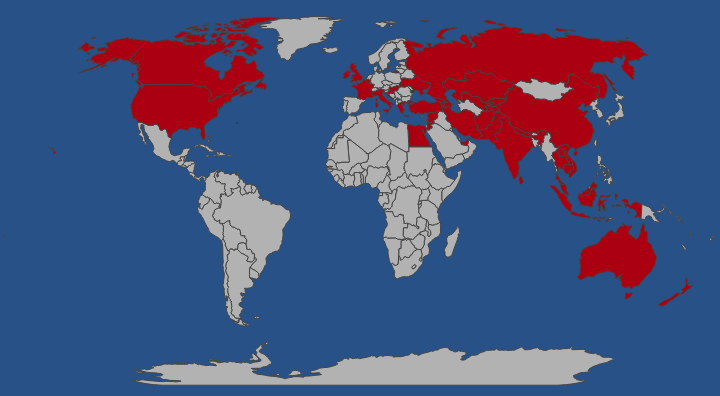
visited 45 states (20.74%)